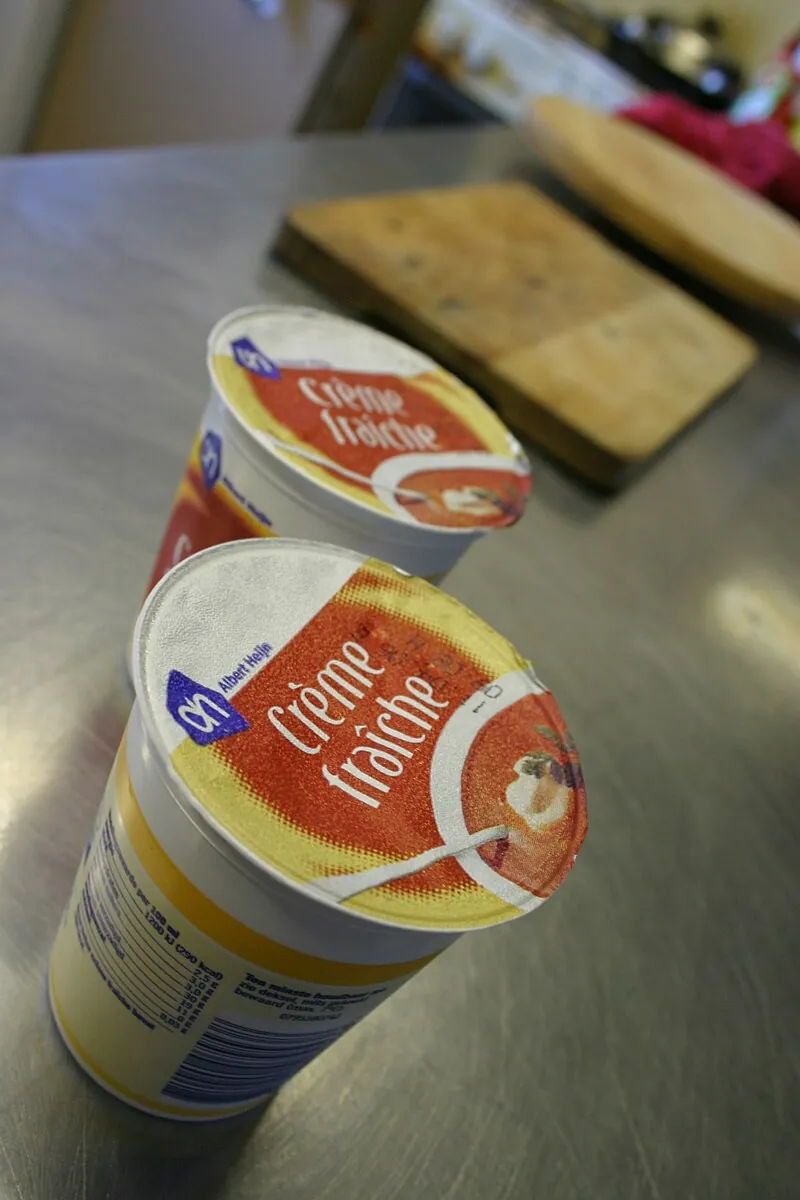
Crème fraîche and sour cream look almost identical in a bowl. Both are white, cultured cream products with a mild tang. Both are used as toppings, in dips, and in sauces. Recipes from France and those from the United States treat them as roughly equivalent, and in a cold application, they broadly are. But in a hot application, on a pan sauce or a soup, the difference between them is the difference between a sauce that holds together and one that splits into a greasy, curdled mess. The reason is fat, and understanding the fat content difference between these two products is the single most useful piece of kitchen chemistry you can apply to cream-based cooking. Everything else about crème fraîche and sour cream follows from that.
How Crème Fraîche Is Made
Crème fraîche is a French cultured cream product made from high-fat cream (at minimum 30% fat, typically 35–40% in traditional production) inoculated with a bacterial starter culture of Lactococcus lactis subsp. lactis and Lactococcus lactis subsp. cremoris. These mesophilic bacteria ferment at room temperature, producing lactic acid that drops the pH of the cream and causes it to thicken. The fermentation continues for 12–24 hours at 20–25°C until the cream has reached the target acidity and the desired thick, spoonable consistency.
The high fat content of the base cream is what defines crème fraîche's cooking properties. Unlike milk or lower-fat cream, the fat in crème fraîche forms a continuous phase that stabilises the protein structure under heat. When crème fraîche is added to a hot sauce, the fat coats the denatured proteins and prevents them from aggregating into curds. The sauce stays smooth. This fat-stabilisation mechanism is why crème fraîche can be boiled briefly in a sauce without breaking, while sour cream cannot.
In France, crème fraîche exists in two commercial forms: crème fraîche épaisse (thick, 30–40% fat, the version used in cooking and as a topping) and crème fraîche liquide (pourable, similar fat content but processed differently to remain liquid). British supermarket crème fraîche (Waitrose, Tesco, Sainsbury's own-brand) is typically 30–40% fat and closely approximates the French product. "Half-fat" crème fraîche (15–18% fat) is also widely available: it has a lighter flavour and is useful as a topping, but it is significantly less stable under heat than the full-fat version.
How Sour Cream Is Made
Sour cream uses the same bacterial cultures as crème fraîche, the fermentation process is identical, and the flavour of the finished product is broadly similar. The difference is in the base cream. American sour cream is made from cream with a fat content of 18–20%; light sour cream (also widely available) is 12–15%. UK soured cream (note the British spelling: "soured" rather than "sour") is typically 15% fat. These fat levels are half or less of those in crème fraîche.
Commercial sour cream also routinely contains stabilisers (modified starch, guar gum, carrageenan) that help maintain the creamy texture and prevent whey separation during the product's shelf life. These stabilisers are absent in traditional crème fraîche. The stabilisers do not help with heat stability in cooking: the fundamental protein-coagulation problem occurs regardless of whether a starch stabiliser is present.
The Critical Difference: Heat Stability
The practical consequence of the fat content gap is absolute in hot cooking. Sour cream begins to split at around 60°C: the heat denatures the whey proteins faster than the fat phase can stabilise them, and the cream separates into white protein curds floating in a watery, greasy liquid. This splitting is irreversible. Once a sour cream sauce has curdled, no amount of stirring, adding cornstarch, or whisking will restore a smooth emulsion.
Crème fraîche, by contrast, can be added to a sauce that is at a full simmer (around 90–95°C) and will remain stable, provided it is stirred in gradually rather than poured in all at once. It can even be brought to a brief boil in a sauce without splitting, which makes it uniquely useful for pan sauces where deglazing and reduction happen at high heat.
The practical rule: in any recipe that involves heating the cultured cream product, use crème fraîche. In any recipe where the cream product stays cold, the two are interchangeable with minor flavour differences.
Regional Variants and Comparisons
Russian Smetana
Smetana is the Eastern European cultured cream product, particularly associated with Russian, Ukrainian, Polish, and Czech cooking. It spans a wide fat range: Russian smetana runs from 20% to 40% fat, with the higher-fat versions functionally equivalent to crème fraîche in cooking applications. The 20% variety is the closest to American sour cream; the 30–40% variety is a direct crème fraîche equivalent and is used in exactly the same cooking applications: beef stroganoff, borscht garnish, pelmeni topping, and blini filling. In the UK, smetana is available from Eastern European food shops (Polonez, Baltic Foods) and some larger supermarkets. For cooking purposes, a high-fat smetana (30%+) is interchangeable with crème fraîche.
UK Soured Cream vs US Sour Cream
British soured cream (15% fat) is noticeably thinner and less rich than American sour cream (18–20% fat). Neither approaches crème fraîche's fat content. Both are best used cold. For a recipe written by a British food writer that calls for "soured cream in a sauce," the writer almost certainly means crème fraîche; the linguistic distinction between soured cream and crème fraîche is sometimes blurred in British food writing in ways that can mislead American readers using the recipe.
Mexican Crema
Mexican crema (crema Mexicana) is a cultured cream product at 18–30% fat, with a milder, less sour flavour than sour cream and a more pourable consistency. It occupies a position between crème fraîche and sour cream in terms of fat content and heat stability. It is the standard garnish for tacos, enchiladas, and soups in Mexican cooking, drizzled rather than spooned. Its more neutral flavour compared to the sharper tang of American sour cream makes it a useful topping for dishes where you want the cream to complement rather than contrast with the main flavours.
How to Make Crème Fraîche at Home
Homemade crème fraîche is one of the simplest kitchen fermentations and requires no specialist equipment or cultures. The method:
- Pour 240ml (1 cup) of double cream (UK) or heavy cream (US) into a clean jar. The cream must not be UHT-treated.
- Add 1 tablespoon of cultured buttermilk. The live bacteria in the buttermilk act as the starter culture.
- Stir briefly, cover the jar loosely with a clean cloth or lid left slightly ajar (to allow CO2 to escape), and leave at room temperature (20–22°C) for 12–24 hours.
- The cream will thicken to a spoonable consistency as the bacteria produce lactic acid. The time required varies with ambient temperature: warmer kitchens (25°C) may take only 8–10 hours; cooler kitchens (18°C) may need 24–30 hours.
- Once thickened to your preference, seal the jar and refrigerate. The crème fraîche will continue to thicken slightly in the fridge and keeps for up to 2 weeks.
The result is essentially identical to shop-bought crème fraîche in cooking performance, and the flavour is often cleaner and fresher. Cost: approximately 80p per 240ml serving using supermarket double cream and buttermilk, versus £1.20–£1.60 for an equivalent amount of branded crème fraîche. Alternative starters that work in place of buttermilk: a tablespoon of plain yogurt (provides the same Lactococcus cultures), a tablespoon of an existing batch of crème fraîche (propagation), or a teaspoon of white wine vinegar (produces thickening through acid but without the probiotic bacterial cultures, so it lacks the complex flavour of fermented crème fraîche).
Uses by Category
Crème Fraîche: Where It Belongs
- Hot pan sauces: Deglaze the pan with wine or stock, reduce by half, then stir in 2–3 tablespoons of crème fraîche over medium heat. The sauce emulsifies and thickens in 60–90 seconds without splitting. Classic applications: chicken with tarragon cream sauce, mushroom and garlic cream pasta, sole meunière with cream.
- Beef stroganoff: The defining use of crème fraîche in Western European cooking. Add at the very end, stir to combine, and serve immediately without further boiling.
- Fish dishes: Crème fraîche's mild tang and heat stability make it ideal for baked salmon (spread over the top before roasting), smoked fish pâtés, and seafood chowders where the cream is added to a simmering soup.
- Dessert topping: The slight tartness of crème fraîche makes it a more interesting accompaniment to tarts, fruit, and crumbles than plain whipped cream. It provides contrast to sweetness rather than amplifying it.
- Quiche and baked egg dishes: Crème fraîche thinned with egg yolks makes a richer, more stable custard than cream for quiche Lorraine and similar tarts.
Sour Cream: Where It Belongs
- Cold dips: Sour cream's lower fat content gives it a lighter, less cloying texture for cold dips than crème fraîche. Sour cream and chive dip for baked potatoes is the canonical use. Nachos, tacos, and fajitas are classically served with sour cream (or Mexican crema) as a cooling contrast to hot, spiced components.
- Cheesecake: Sour cream baked into a New York cheesecake (spread over the top in the final minutes of baking, or mixed into the filling) adds tang and a slight lightening effect. The acidity of sour cream sets the surface and adds flavour complexity.
- Cold dressings: Sour cream thinned with a little lemon juice and dill makes an excellent dressing for cucumber salad, potato salad, and cold beetroot dishes.
- Baked goods: Sour cream in cake batter (coffee cake, red velvet) adds moisture and tenderness via its fat content, and the acidity activates bicarbonate of soda leavening. It is interchangeable with crème fraîche in this application, though crème fraîche produces a very slightly richer crumb.
- Cooling garnish: Sour cream spooned onto hot soup (borscht, roasted red pepper soup) at the table melts into the surface attractively. It will split if stirred into the soup while it is on the heat.
Substituting One for the Other: The Honest Guide
The following breakdown applies in practical cooking situations:
- Cold applications (dips, dressings, garnishes, cold cheesecake fillings): Fully interchangeable. Crème fraîche will be richer and slightly less tangy; sour cream will be lighter and slightly more acidic.
- Baking (cakes, muffins, bread): Fully interchangeable. The fat content difference has minimal effect in baked goods where the cream is diluted through a large batter.
- Hot sauces and soups (cream stirred in during cooking): Crème fraîche only. Sour cream will split. Half-fat crème fraîche is also at risk of splitting; use full-fat.
- Baked cheesecake filling: Sour cream is traditional in New York cheesecake; crème fraîche works but produces a somewhat richer, more European-style result.
- Stroganoff and similar heat-finished cream sauces: Crème fraîche only. Or add sour cream off the heat, stir immediately, and serve without reheating.
If a recipe calls for sour cream in a hot application, the recipe is either using the wrong ingredient or relying on the sauce not reaching splitting temperature. Either way, substituting crème fraîche eliminates the risk without affecting the flavour appreciably.
Related: Cream Types Guide: Double, Single, Whipping, and Clotted | Ricotta vs Cottage Cheese: What's the Difference and When to Use Each