Skyr has been made in Iceland for more than a thousand years. The Landnámabók, a 12th-century Norse manuscript recording the 9th-century settlement of Iceland, contains references to skyr as a food the settlers brought with them from Scandinavia, where the product subsequently disappeared while Iceland preserved the tradition unbroken. Today, skyr is Iceland's most consumed dairy product and, following a rapid global expansion beginning around 2015, one of the fastest-growing segments of the European and North American premium dairy market. What makes skyr genuinely unusual is that despite its thick, creamy, yogurt-like appearance, it is technically a fresh acid-set cheese, not a fermented milk product in the yogurt sense. The distinction matters nutritionally and culinarily.
What Skyr Actually Is: Fresh Cheese, Not Yogurt
The classification of skyr as a cheese rather than a yogurt rests on its production process. Skim milk is heated, cooled to approximately 40°C, and then cultured with a specific blend of bacterial strains. Crucially, a small amount of rennet is traditionally added, which triggers the curd to form in a way that fermented-milk yogurts do not replicate. The curd is then strained extensively through cloth, removing the vast majority of the whey and concentrating the protein. The result is a product with the thick, almost spreadable density of cream cheese but the near-zero fat content of skim milk.
The bacterial strains used in authentic Icelandic skyr include Streptococcus thermophilus and Lactobacillus bulgaricus (both common to yogurt) alongside specific Icelandic strains that Icelandic producers have maintained through continuous culture for centuries. These cultures are passed from batch to batch in the same way sourdough starter is maintained, and they contribute to the specific mild, clean tang that distinguishes Icelandic skyr from commercial "skyr-style" products made outside Iceland with approximated cultures.
Nutritional Profile: Skyr vs Greek Yogurt
Skyr's growing reputation in fitness and health communities rests on a genuinely strong nutritional case. Per 100g of plain, full-fat-free skyr:
- Protein: 10–11g (vs 8–9g for strained Greek yogurt)
- Fat: 0.1–0.5% (vs 0–5% for Greek yogurt depending on variety)
- Carbohydrates: 4g (vs 3.5–4g for Greek yogurt)
- Calories: approximately 63 kcal per 100g (vs 59–97 kcal for Greek yogurt)
- Calcium: 120–140mg per 100g
The protein advantage over Greek yogurt is modest but consistent, and the fat content is reliably very low in plain skyr. Because it takes approximately four litres of skim milk to produce one litre of skyr after straining, the protein is naturally concentrated in a way that does not require the protein powders or milk solids that some manufacturers add to boost Greek yogurt's numbers.
Brands and What They Actually Contain
The global skyr market is dominated by a handful of brands, ranging from authentic Icelandic producers to large European dairy companies making skyr-style products.
Siggi's is the best-known brand in the United States. Founded in 2005 by Siggi Hilmarsson, a native Icelander living in New York, Siggi's makes Icelandic-style skyr in the US using American milk but Icelandic cultures. The product is lower in sugar than most flavoured European alternatives (the original flavoured range contains 9–11g sugar per 100g, compared to 12–16g in many mass-market yogurts) and is positioned firmly in the premium health food segment at approximately $2.00–2.50 per 150g pot.
Arla Skyr is the largest-selling skyr in the United Kingdom and much of mainland Europe. Arla is a Danish-Swedish dairy cooperative, not an Icelandic producer, and its skyr is made in Denmark. It uses the standard skyr cultures and produces a consistent, widely available product at a mid-market price point (approximately £1.50 per 450g tub at major UK supermarkets).
Ófeigur is a small artisan brand from Iceland that produces skyr using traditional methods and cultures passed down from a single farm. It is rarely exported and is primarily found in Iceland's capital, Reykjavik. For those visiting Iceland, it represents the closest thing to what skyr tasted like before industrialisation.
Müller Corner Skyr and similar mass-market variants use the skyr name but are often made with added thickeners and higher sugar content. They are nutritionally and texturally distinct from authentic skyr and are better understood as skyr-flavoured yogurts.
How Icelanders Actually Eat Skyr
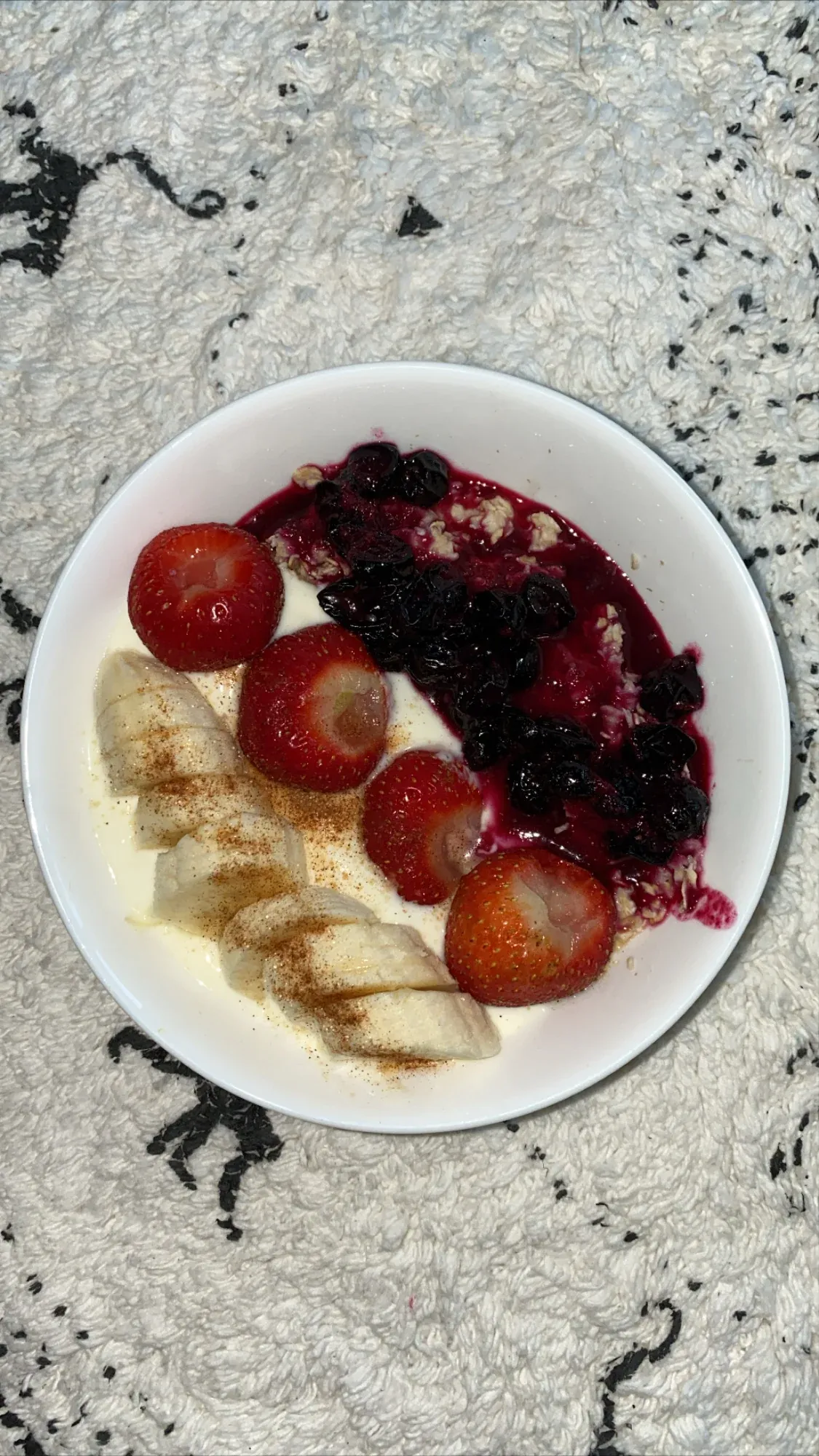
In Iceland, plain skyr eaten with wild bilberries (aðalbláber) and a little sugar is the traditional everyday preparation. The bilberries, smaller and more intensely flavoured than cultivated blueberries, grow wild across the Icelandic highlands and are harvested in August and September.
Skyr með rjóma (skyr with cream) is served at formal meals and celebrations: plain skyr loosened with a little cream and sweetened with sugar, sometimes flavoured with vanilla. The cream paradoxically reduces the calorie savings of choosing skyr, but the combination is genuinely delicious.
Skyr cake (skyrkaka) is Iceland's version of cheesecake. Skyr replaces the cream cheese in a standard cheesecake recipe, producing a lighter, more tangy result. It sets firmly without baking because skyr's dense texture holds its structure with gelatine alone.
Cooking with Skyr
Skyr's thick texture and neutral tang make it a versatile ingredient in the kitchen beyond breakfast bowls.
Lower-fat cheesecake: Replace all or half the cream cheese in a standard no-bake cheesecake with skyr. The result has notably less fat and more protein per slice, and the tang is if anything more pleasant. Add a small amount of gelatine (2g per 500g of skyr) to ensure a firm set.
Smoothies: Skyr blends more smoothly than Greek yogurt due to its finer, more uniform texture. A 150g portion of skyr blended with 200ml of milk, a banana, and frozen berries provides approximately 20g of protein.
Marinade base: The mild acidity of skyr tenderises meat effectively. A marinade of 100g skyr, garlic, cumin, and lemon juice works particularly well for lamb (appropriate given Iceland's sheep-farming heritage) and chicken.
Dips and dressings: Skyr thinned with a little lemon juice and mixed with fresh herbs makes a credible tzatziki-style dip with substantially more protein and less fat than the Greek yogurt original.
Iceland's Dairy Culture and the Global Skyr Boom
Iceland has one of the highest dairy consumption rates per capita in the world. The country's relatively harsh climate and isolation preserved dairy traditions that have since been lost elsewhere in Scandinavia. Icelandic dairy cooperatives, particularly MS (Mjólkursamsalan), have dominated domestic production since the 1930s and have been cautious about exporting the category, fearing quality dilution.
The global boom has largely bypassed Icelandic producers themselves. According to Euromonitor International data, the European skyr and skyr-style product market grew by approximately 300 percent between 2015 and 2022, but the majority of that growth was captured by Arla, Müller, and other European dairy multinationals rather than by Icelandic brands. The protected geographical indication that might have kept "skyr" exclusive to Icelandic producers was never obtained, meaning any manufacturer can label a product as skyr regardless of origin or production method.
For consumers, the practical implication is to read the ingredient list. Authentic skyr contains skim milk and live cultures. Products with added starch, thickeners, or milk solids are likely processed approximations of the original. The nutritional profile is the best guide: genuine skyr will show 10g or more of protein per 100g with less than 1g of fat.
Related: Greek Yogurt vs Regular Yogurt: A Complete Comparison | Quark: Germany's Everyday Fresh Cheese