The relationship between dairy and baked goods is older than recorded history and more scientifically interesting than it might appear. Butter, milk, cream, and buttermilk are not simply sources of fat and liquid in baking — they are complex chemical actors that determine texture, flavour, browning, structure, shelf life, and the specific pleasure of a perfectly made cookie or biscuit. The world's great cookie traditions — from the butter-forward shortbread of Scotland to the crisp, milky biscoitos of Brazil, from the Danish butter cookie to the Lebanese mamoul — are all, at their core, expressions of what dairy can do when heat, sugar, and flour are applied with understanding. And the simple act of dunking a cookie in a glass of cold milk is more chemically interesting than it looks.
The Science: What Dairy Does in a Cookie
Butter: Fat, Water, and Emulsification
Butter is approximately 80% fat, 16–18% water, and 2–4% milk solids. Each component plays a distinct role in cookie baking:
- Fat coats flour proteins, preventing the development of long gluten strands — the mechanism that creates tenderness. More butter = more tender (and more spread-out) cookies. The fat also carries fat-soluble flavour compounds and provides the characteristic richness that is the defining quality of a good butter cookie.
- Water in butter activates leavening (baking soda or baking powder react with moisture to produce CO₂) and produces steam during baking that lifts the cookie structure. Brown butter (butter heated until the water evaporates and the milk solids brown) is used in many cookie recipes specifically to concentrate the fat flavour while eliminating this water content — producing a denser, more intensely flavoured cookie.
- Milk solids (primarily proteins and lactose) participate in the Maillard reaction during baking — contributing the golden-brown colour and the complex, slightly caramelised flavour of a properly baked butter cookie. This is why butter cookies brown more readily and with more complex flavour than cookies made with neutral oils.
Milk and Cream: Structure and Flavour
When liquid milk or cream is added to a cookie dough:
- The proteins in milk (casein and whey) contribute to gluten development when combined with flour and mechanical action — adding structure and chew
- Lactose (milk sugar) browns at a slightly different temperature than sucrose, adding caramel complexity to the flavour profile
- The fat in cream enriches the texture, creates a more tender crumb, and extends shelf life by retarding staling
- Buttermilk specifically provides acidity that activates baking soda (sodium bicarbonate), producing the lift and tenderness characteristic of buttermilk biscuits and scones
Why Cold Milk and Warm Cookies Work
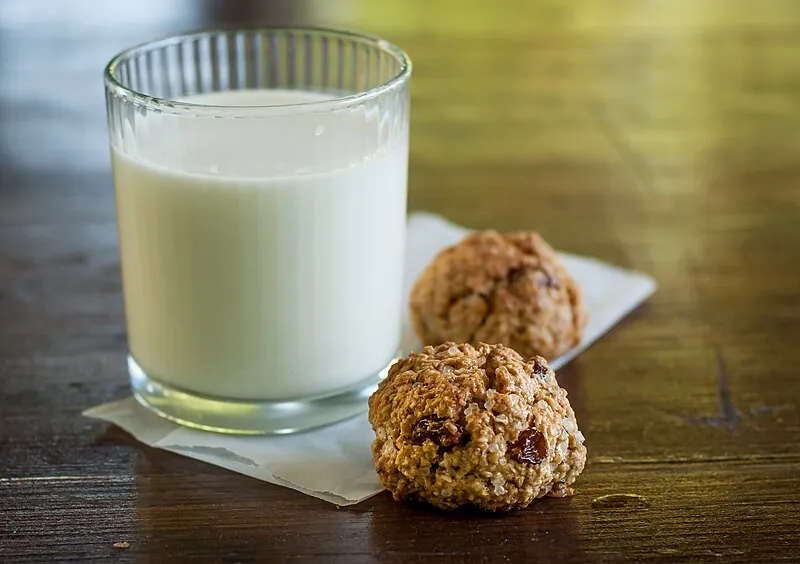
The science behind the cookie-and-milk pairing: milk contains casein proteins that are highly effective at binding with phenolic compounds — including the tannins and bitter flavour compounds in cocoa and dark chocolate. Dunking a chocolate chip cookie in cold milk literally neutralises some of the chocolate's bitterness, creates a fat-in-water emulsion in the mouth that increases richness perception, and the cold temperature of the milk contrasts pleasurably with the warm residual heat of a fresh-from-the-oven cookie. This is not merely cultural conditioning — there is genuine sensory science behind the pairing.
The World's Great Milk-Forward Cookie Traditions
Scottish Shortbread
Possibly the world's most dairy-intensive cookie — pure butter flavour with minimal interference from other ingredients. The classic ratio: one part icing sugar, two parts butter, three parts flour. No eggs, no leavening, sometimes a pinch of salt. The result entirely depends on the quality of the butter: a supermarket-butter shortbread is pleasant; shortbread made with rich, cultured French butter or high-fat Scottish butter is a completely different food — crumbling into sandy, dissolving richness on the tongue, with a deep dairy flavour that lingers. Walker's Shortbread (Aberlour, Scottish Highlands) has been the global ambassador of this tradition since 1898.
Danish Butter Cookies (Smørkager)
The Danish butter cookie in its distinctive blue tin — sold globally under brands like Royal Dansk and Kelsen — is one of the world's most recognisable packaged foods. The original version: pressed through a piping bag into rosette and pretzel shapes, baked until pale golden, with a delicate crispness and pure butter flavour. The genuine Danish version (made with high-fat Danish butter, which exceeds the EU minimum by several percentage points) has a depth of flavour that the many international imitators — substituting cheaper fats — do not replicate. The blue tin has become a cultural joke (everyone's grandmother kept sewing supplies in one) that underestimates the quality of its contents.
Biscoito de Leite (Brazil)
Brazil's biscoito de leite — milk cookie — is one of the country's most beloved everyday biscuits: crisp, subtly sweet, with a clean dairy flavour and a delicate crunch that collapses pleasantly. Made with milk powder and whole milk integrated into the dough, the cookie is specifically engineered around dairy flavour rather than using milk as a mere hydrator. The industrial versions (brands like Bauducco and M. Dias Branco) are produced by the billions annually; artisan versions from small bakeries have been gaining a premium market in Brazilian cities with the growth of coffee culture and pairing consciousness.
Maria Biscuits (Spain, Portugal, UK)
The Maria biscuit — a simple, circular, lightly sweetened wheat biscuit with a subtle dairy note — is one of the world's best-selling biscuits and one of its most underestimated. Named for Princess Maria of England (whose 1878 marriage to the Russian Grand Duke Vladimir was the occasion for which the biscuit was created by the London baker Peek Freans), it spread through Spanish and Portuguese consumer markets during the 20th century and is now one of the most consumed biscuits in the Spanish-speaking and Lusophone worlds. At its best (Marbú in Spain, Digestivos in Portugal, McVitie's in the UK), the Maria biscuit has a specific clean wheaty-dairy character designed for tea dunking — the structural integrity to withstand brief immersion without disintegrating, absorbing enough liquid to soften slightly while retaining its shape.
Lebanese Mamoul
The mamoul is a shell-moulded shortbread cookie of the Middle East, made with semolina flour, abundant butter or clarified butter, and rose water or orange blossom water — filled with date paste, walnut, or pistachio. The dairy component (butter) is the binder and enricher; the result is crumbly, intensely flavoured, and among the world's most sophisticated traditional cookies. Made throughout Lebanon, Syria, Jordan, Palestine, Iraq, and the broader Arab world for Eid celebrations and at Easter for Christian communities (the same cookie, same recipe, different celebration).
The Art of Pairing: Which Milk with Which Cookie?
- Whole milk (cold): The classic pairing for chocolate chip cookies, brownies, or any chocolate-forward cookie. The fat and casein work together to balance bitterness and add richness.
- Warm whole milk: For shortbread and pure butter cookies — the warmth amplifies the butter aromas in the cookie; no competition from cold temperature.
- Oat milk: Works surprisingly well with mild, lightly sweetened cookies — the neutral oat flavour doesn't compete; reasonable fat content provides some richness
- Coffee with milk: The European tradition — Spanish galletas dunked in café con leche; Italian biscotti dipped in cappuccino; the slight bitterness of coffee balancing the sweetness of the biscuit
Related: The Science of Ice Cream: Dairy Transformed by Cold | Condensed Milk: The Ingredient That Changed Global Baking