The Middle East is, arguably, the birthplace of dairy culture. The first cattle were domesticated in the Fertile Crescent; the first cheese-making tools were found in present-day Turkey and Iraq; Sumerian dairy friezes are among the oldest depictions of human food production. And yet the region's own dairy traditions remain largely unknown to the wider world, overshadowed by the European dairy narrative. Here is a deep dive into one of the world's oldest and most fascinating milk cultures.
The Deep Roots: Dairy in the Ancient Fertile Crescent
The earliest solid evidence of dairying comes from the Fertile Crescent — the arc of territory spanning modern Iraq, Syria, Lebanon, Jordan, Israel, and southern Turkey. Around 7,000–8,000 BCE, the region's early agricultural communities were already processing milk into butter and cheese.
The famous Warka Vase (c. 3,200 BCE, from Uruk in modern Iraq), now in the National Museum of Baghdad, depicts cows being milked in procession. Sumerian cuneiform tablets describe dairy operations and cheese varieties in systematic detail — not as luxuries but as staple agricultural products.
The biblical tradition is rich with dairy references: the land of Israel is described as a "land flowing with milk and honey." Milk, curds, cheese, and butter appear throughout the Hebrew scriptures as symbols of abundance and divine blessing.
Camel Milk: The Desert's Liquid Gold
In the arid interior of the Arabian Peninsula, the Sahara, and the Sahel, where cattle cannot survive, the dromedary camel has been the primary dairy animal for millennia. Bedouin communities have relied on camel milk as a near-complete food source during desert crossings and droughts.
Camel milk has remarkable properties:
- Lower in fat than cow's milk but higher in certain vitamins and minerals
- Rich in lactoferrin — an antimicrobial protein with immunological properties
- Contains insulin-like proteins that may have benefits for diabetics (under ongoing research)
- Lower in lactose than cow's milk — generally tolerable by lactase non-persistent individuals
- Contains unique immunoglobulins (small antibodies) with potential therapeutic applications
Camel milk is traditionally consumed fresh or slightly fermented (suusac in Somalia, gariss in Kenya). It cannot be made into butter or regular cheese using conventional methods because its fat globules are too small and do not agglomerate easily — a challenge that artisan producers in the UAE and Kenya are working to solve.
Today, camel milk is an emerging luxury product. The UAE-based company Camelicious exports pasteurised camel milk globally, and camel milk chocolate has become a Dubai souvenir staple.
Labneh: Yoghurt Elevated to Art
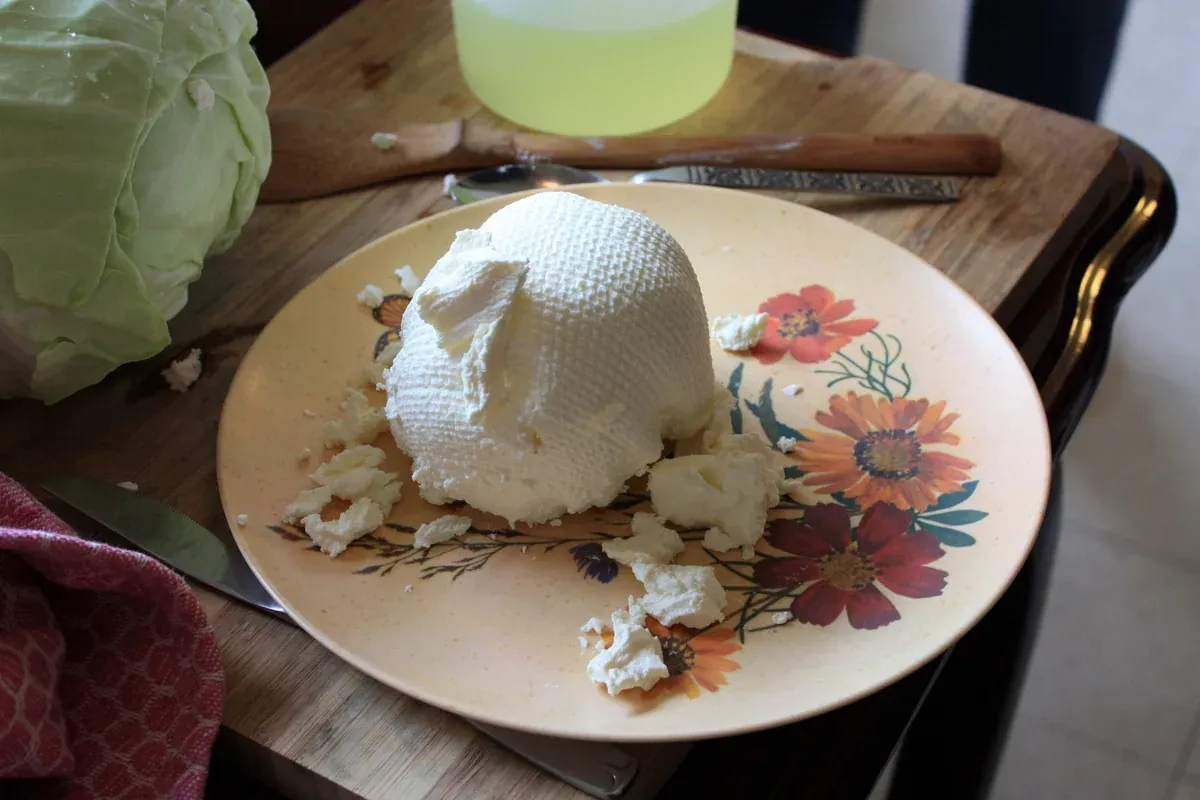
Labneh (also spelled labne, labni, or labnah) is strained yoghurt reduced to a thick, tangy, cream-cheese consistency. It is one of the most versatile and ancient dairy products in the Middle Eastern pantry, found across Lebanon, Syria, Jordan, Palestine, Egypt, and beyond.
At its simplest, labneh is eaten on flatbread with olive oil and za'atar (thyme and sesame spice mix) for breakfast. In its preserved form, labneh balls are rolled in herbs (dried mint, thyme, chilli flakes) and stored submerged in olive oil in glass jars — a form of dairy preservation that predates refrigeration by thousands of years.
Labneh made from goat's milk has a sharper, more complex flavour. Some artisan producers in Lebanon and Jordan are now making aged labneh — pressed for weeks or months until semi-firm — that approaches the complexity of a young French chèvre.
Leben, Ayran, Laban: The Region's Fermented Milk Drinks
Fermented milk drinks are central to Middle Eastern daily life:
- Laban: A thin, drinking-consistency yoghurt beverage consumed across the Levant, often salted and served cold with meals
- Ayran: The Turkish equivalent — yoghurt blended with water and salt — now sold commercially across Turkey and the Gulf and increasingly in European markets
- Leben raïb: In the Maghreb (Morocco, Algeria, Tunisia), this set yoghurt-like fermented milk is a daily staple
- Jameed: A unique Jordanian product — hard, dried, salted goat or sheep's milk — used to make mansaf, Jordan's national dish. Jameed is reconstituted with hot water to make a rich broth that bathes rice and lamb
Halloumi: From Cyprus to the World
While technically from Cyprus — a Mediterranean island at the crossroads of Middle Eastern and European culture — halloumi is deeply rooted in the Levantine dairy tradition. Made from a mixture of sheep's and goat's milk (with cow's milk often added commercially), halloumi's defining characteristic is its high melting point, which allows it to be grilled or fried without losing its shape.
Halloumi is now one of the world's fastest-growing cheese categories, exported globally and a staple of British supermarkets, Middle Eastern restaurants worldwide, and increasingly North American menus. In 2021, Cyprus secured Protected Designation of Origin (PDO) status for traditional halloumi — a recognition of its unique geographic heritage.
The Gulf's Booming Modern Dairy Industry
Despite the region's arid climate, the Gulf states have invested heavily in domestic dairy production. The most extraordinary example is Al Rawabi Dairy in the UAE and Almarai in Saudi Arabia — the latter being the world's largest vertically integrated dairy company, farming thousands of Holstein cows in the Saudi desert using sophisticated cooling, feeding, and irrigation systems.
Saudi Arabia's Al Safi Danone farm complex near Al Kharj once held over 30,000 dairy cows in a fully climate-controlled, desert dairy operation — a feat of agricultural engineering that would have seemed impossible to the region's Bedouin ancestors. The Gulf's dairy self-sufficiency ambitions, driven partly by geopolitical food security concerns and partly by population growth, have created a modern dairy industry in one of the world's least dairy-friendly climates.
A Living Dairy Culture
The Middle East is not just the historical birthplace of dairy — it remains a living dairy culture, from the labneh spread on morning bread in a Beirut apartment to the fermented camel milk shared in a Bedouin tent on the Arabian Peninsula. As Western dairy markets evolve and consumers seek authenticity, the Middle East's ancient dairy traditions may be about to have their moment on the global stage.
Related: The History of Milk | Milk During Wars