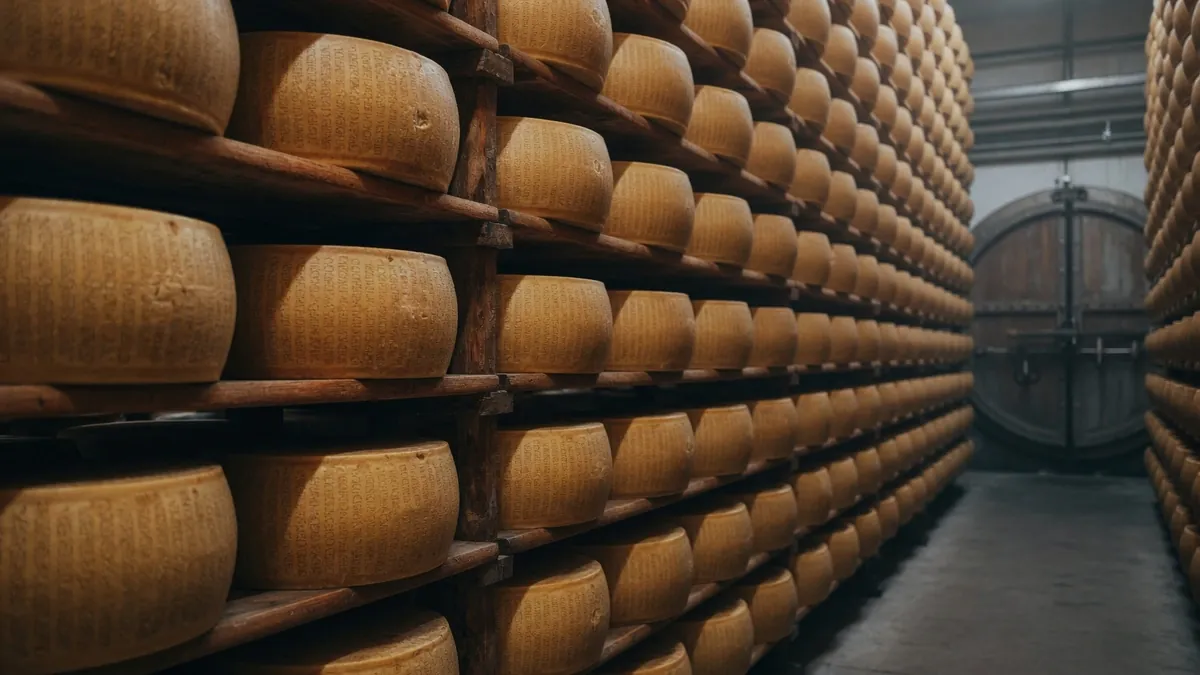
Picture a bank vault: the heavy round door, the guards, the shelves stacked with gold bars. Now take away every bar and replace it with a wheel of cheese. That is not a metaphor. In the Emilia-Romagna region of northern Italy, a real bank keeps vaults packed, floor to ceiling, with wheels of Parmigiano-Reggiano — and it lends out millions of euros against them. To understand why a serious financial institution would hoard cheese, you first have to understand just how slow, and how valuable, real Parmesan is.
Why real Parmesan is so expensive to make
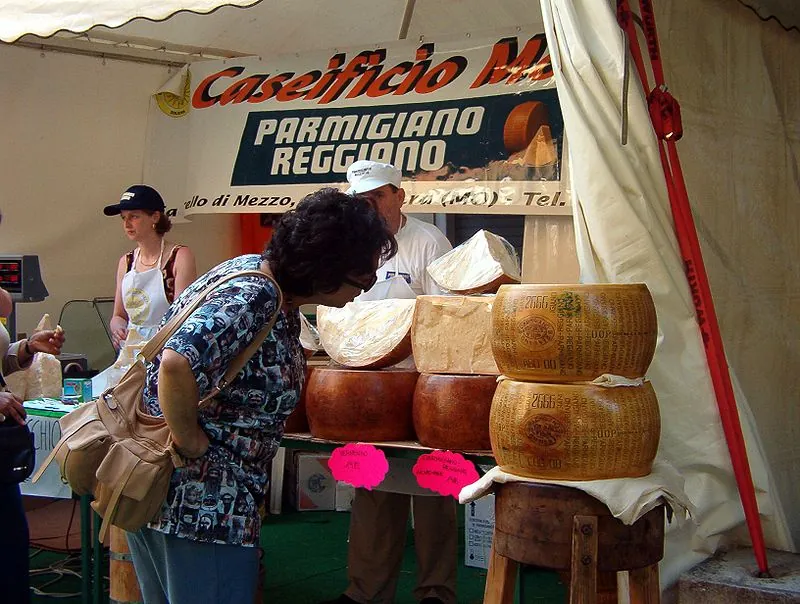
Authentic Parmigiano-Reggiano — the hard, golden, faintly crystalline cheese, not the powder in a tub — is gloriously slow. A single wheel weighs around 40 kilograms and requires roughly 550 litres of milk, made the traditional way from raw cow's milk in copper vats with calf rennet. Then comes the hard part: it must age. By the rules of its protected designation, the minimum is twelve months; the prized stuff matures for two or three years, slowly developing the crunchy tyrosine crystals connoisseurs prize.
Here is the cheesemaker's problem. For every one of those months, they have already spent the money — the milk is bought, the workers are paid — but earned nothing back. The wheels just sit on a shelf, ripening. A small dairy can have a genuine fortune locked in its cellar and still not have the cash to pay this month's bills. For centuries, that was simply the curse of making Parmesan.
Then a bank had an idea
In 1953, the bank Credito Emiliano (Credem) looked at all those aging wheels and saw something other than lunch: collateral. The deal is elegant. A cheesemaker brings young wheels to the bank, and the bank issues a loan secured by the cheese itself — a mortgage, but cheesier. The crucial twist is that the bank does not simply take an IOU and a photograph. It physically takes the wheels, and stores them itself.
A vault that is actually a cheese cellar
Credem runs its own enormous, climate-controlled warehouses — reportedly holding on the order of hundreds of thousands of wheels at a time, with a collateral value running into the hundreds of millions of euros. (The exact figures float around depending on the year and the source, so treat them as ballpark.) Temperature, humidity and airflow are all managed, because this collateral is alive and still maturing. The bank even employs specialists who inspect the stock by tapping each wheel with a small hammer and listening to the echo for hidden cracks and air pockets — a genuine Parmigiano quality-control technique. And here is the quiet genius of it: while the cheese sits in the vault, it gets better. The collateral improves itself.
What if you can't repay?
When the loan is repaid, the cheesemaker collects their now-older, more valuable wheels, sells them, and pockets the difference. If they default, the bank does what any lender does with collateral — it sells it. Foreclosure, in this case, means auctioning a small mountain of Parmesan. That is a real risk: if cheese prices fall, the bank can lose, which is why it only ever lends a fraction of each wheel's value.
There is also a danger most banks never have to plan for: theft. Aged Parmesan (and its cousin Grana Padano) is so valuable that Italy has a recurring problem with organized cheese heists, with thieves making off with dozens or hundreds of wheels in a single raid. The defence is baked right into the rind: every genuine wheel is branded all the way around with thousands of tiny dotted letters — its name, its dairy, and its date — plus an oval casein plate. It is, in effect, a serial number you can eat, which makes fakes obvious and stolen wheels hard to fence.
Why cheese behaves like gold
Why does any of this work? Because aged Parmigiano-Reggiano is unusually stable value. It does not spoil for years, global demand is steady, and its price rarely crashes. It is durable, storable, gradable, traceable, and it appreciates as it ages — which is a remarkably good description of a hard asset. It is, more or less, edible gold that happens to be delicious on pasta. For the cheesemaker, the bank unlocks money that was trapped in the cellar; for the bank, it is a loan backed by something it can store, inspect, insure and sell. The model has worked for more than seventy years, and the idea has since drifted toward a few other prized, slowly-aging foods like cured ham and fine wine.
So the next time someone brags about their "liquid assets," picture the vault in Italy where the assets are solid, golden, and aged to perfection — and where the single richest thing in the bank is the cheese.
Sources and further reading
- Credito Emiliano (Credem) — reporting on its Parmigiano-Reggiano collateral lending and cheese warehouses (Bloomberg, BBC, Reuters features).
- Consorzio del Formaggio Parmigiano-Reggiano — production standards: milk per wheel, wheel weight, minimum aging, copper vats, and rind branding.
- Reporting on organized cheese theft of Parmigiano and Grana Padano in Italy.
- Food-science references on tyrosine / calcium-lactate crystal formation in long-aged hard cheeses.
Note: wheel counts and euro values are approximate and vary between sources and years; they are given here as ballpark figures. This is food-science storytelling, not financial advice.
Milkiry — the science of milk, the craft of cheese, and the food behind it. Watch the episode and subscribe.