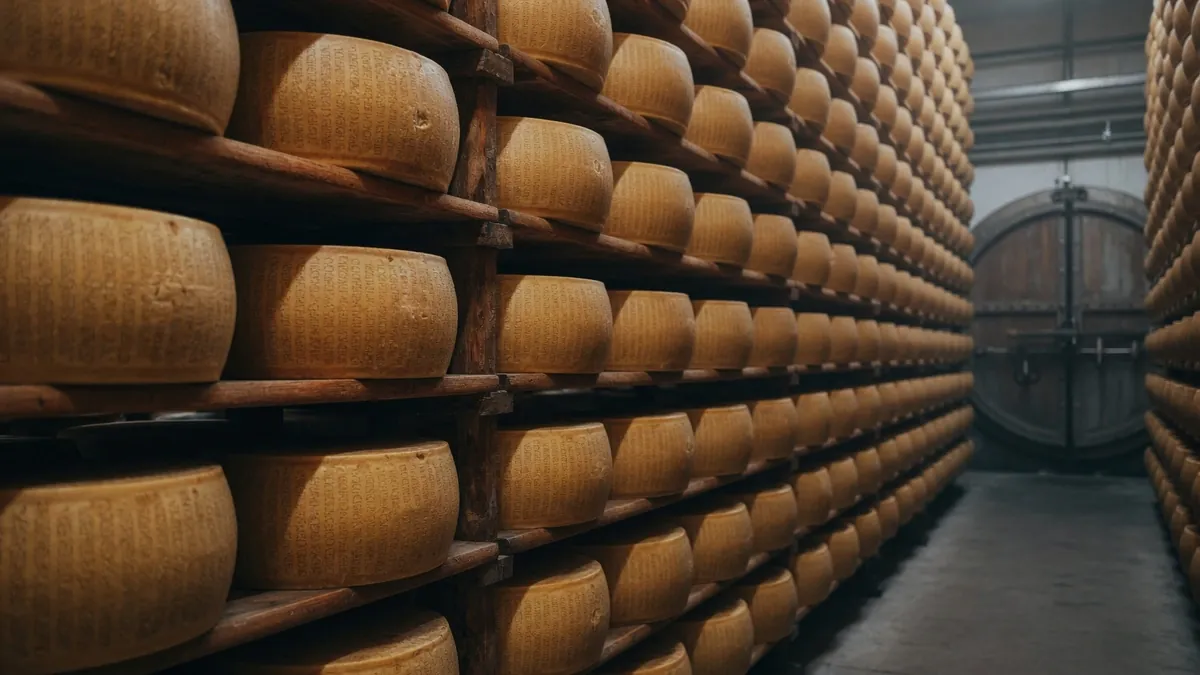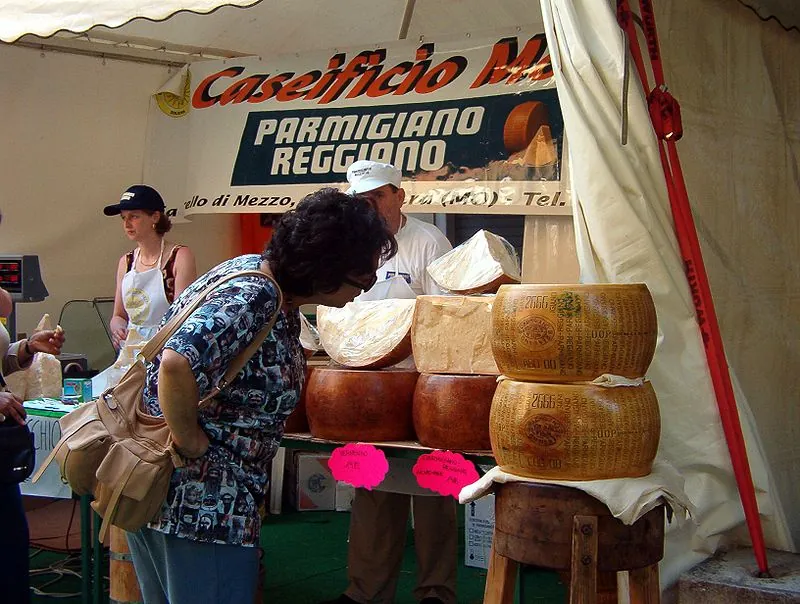
Parmigiano-Reggiano is protected under European Union PDO (Protected Designation of Origin) law, which means the name can only legally be applied to cheese produced in a precisely defined geographic area of northern Italy using strictly regulated methods. It has been made in essentially the same way for nearly nine centuries: the earliest documentary evidence dates to 1254, when a notarial deed in Genoa recorded a sale of "caseus parmensis." Today, the Parmigiano-Reggiano Consortium oversees the production of 3.9 million wheels per year, each weighing 38 to 40 kilograms and requiring approximately 550 litres of milk to produce. No other hard cheese in the world combines this level of regulated production, verifiable provenance, and flavour complexity, which is why it commands prices of €10 to €22 per kilogram at the rind and considerably more for extended-aged examples.
The PDO Rules: Geography and Production
The PDO designation specifies that Parmigiano-Reggiano can only be produced in the provinces of Parma, Reggio Emilia, and Modena, and in parts of Bologna (specifically west of the Reno river) and Mantova (east of the Po river). These boundaries are not arbitrary: they define a region with specific cattle breeds (predominantly Italian Friesian, also known as Holstein), specific feeding rules (no fermented feeds or silage, which would introduce undesirable bacteria into the raw milk), and centuries of cheese-making tradition concentrated in small, family-operated caseifici (dairies).
The milk must be raw (unpasteurised), collected twice daily from the caseificio's partner farms, and processed within two hours. The evening milk is partially skimmed by resting overnight and removing the cream layer. This skimmed evening milk is blended with the following morning's full-fat milk, producing a partially skimmed mixture that gives Parmigiano-Reggiano its characteristic fat-to-protein ratio. No additives, no preservatives, and no colourants are permitted. The only ingredient aside from milk is natural whey starter (from the previous day's production) and sea salt used during brining.
The Aging Process: What Time Does to the Cheese
The PDO rules require a minimum aging of 24 months, though the Consortium sells cheese at three main maturation stages, each with a distinct flavour profile and official fire mark (a heat stamp burned into the rind).
24-Month (Minimum Legal Age)
At this stage, the cheese is golden-yellow inside with a relatively moist paste. The flavour is sweet, milky, and fruity, with notes of fresh pineapple and butter. The texture is slightly grainy but not yet fully crystalline. This is the most widely exported age category and the one found in most supermarkets outside Italy. The fire mark is a single band around the wheel.
36-Month
By 36 months, proteolysis (the enzymatic breakdown of proteins into peptides and amino acids) has progressed far enough to produce the distinctive white crystalline deposits visible throughout the paste. These are tyrosine crystals, an amino acid that precipitates out of solution as the protein matrix breaks down. The flavour has deepened considerably: strong umami, caramel, toasted nuts, and a dry, almost flaky texture. This is the preferred eating age among connoisseurs in Italy. The fire mark shows a double band.
40-Month and Beyond
Extended-aged Parmigiano-Reggiano (stravecchio, meaning "extra old") is sharp, intensely savoury, and almost spicy on the palate. The texture is very dry and crystalline throughout. It is best eaten in small quantities as a standalone cheese with a drizzle of aged balsamic vinegar, or finely grated over dishes where its intensity is desired. At specialty cheese shops, 40-month wheels can cost €25 to €35 per kilogram.
How to Identify the Real Thing
Several verification systems exist to distinguish genuine Parmigiano-Reggiano from imitations.
The dotted rind: Every authentic wheel has the words "PARMIGIANO-REGGIANO" stamped in dotted letters around the entire circumference of the rind, applied during production using a specially coded stencil. If you buy a wedge, look for this inscription on the outer edge.
The fire mark: The Consortium's quality inspectors examine every wheel at 12 months. Wheels that pass are branded with the oval Parmigiano-Reggiano fire mark. Wheels that fail are deep-scored across the rind to prevent them from being sold under the PDO name.
The QR code: Since October 2020, the Consortium has applied an individual casein plate to every wheel bearing a unique QR code that links to the specific dairy, production date, and quality record. Scanning this code confirms provenance to the individual wheel level. It is the most rigorous food authentication system currently operating at scale in European cheese production.
The PDO oval label: Cut wedges sold by reputable retailers should carry a gold-oval PDO sticker alongside the retailer's own label. Without the rind inscription and this mark, there is no guarantee of authenticity.
Grana Padano vs Parmigiano-Reggiano
Grana Padano is the other major PDO Italian hard cheese and the one most often used as a cheaper substitute for Parmigiano-Reggiano. Both are PDO-protected granular cheeses made from raw cow's milk in northern Italy, but they differ in several significant ways.
Grana Padano's production area is larger, covering much of the Po Valley, and includes regions outside the strict Parmigiano-Reggiano zone. The minimum aging requirement is only nine months (versus 24 months), though it is also sold at 16-month and over-20-month grades. Silage feed is permitted for the cattle, which introduces different bacterial populations and affects flavour. The result is a milder, slightly less complex cheese that costs approximately 30 to 40 percent less per kilogram. For cooking purposes (grating over pasta, incorporating into sauces), Grana Padano is a perfectly reasonable choice. For eating as a table cheese, the difference in depth and complexity at equivalent ages is noticeable.
"Parmesan" Outside the EU: The Problem
In countries outside the European Union, including the United States, Canada, and Australia, the name "Parmesan" is not legally restricted to Parmigiano-Reggiano. This has allowed manufacturers to produce generic "Parmesan" cheeses that bear no relationship to the Italian original. The issue gained widespread attention after a 2016 Bloomberg investigation found that certain US "100% Parmesan" products, including some sold under the Kraft label, contained cellulose (wood pulp) as an anti-caking agent at levels above the FDA's informal 2–4 percent tolerance. The US FDA subsequently issued a warning to several manufacturers. When buying Parmesan outside the EU, look explicitly for "Parmigiano-Reggiano" with the PDO mark on the rind, not generic "Parmesan."
Storage and How to Use the Rind
Pre-grated Parmigiano-Reggiano oxidises within hours of grating, losing its aromatic volatile compounds rapidly. Always buy Parmigiano-Reggiano in wedge form and grate it immediately before use. Store the wedge wrapped in damp cheesecloth or parchment inside a sealed container in the refrigerator, where it will keep for three to six weeks.
The rind is one of the most underused parts of the cheese. It is food-safe and adds an intense umami depth when simmered in soups, risotto, or tomato sauce. Add one or two pieces of rind to a pot of minestrone or a long-cooked ragù, and remove before serving. The collagen and proteins in the rind dissolve slowly into the liquid, enriching the base in a way that grated cheese cannot match.
When buying a wedge, look for a cheesemonger who cuts to order from a whole or half wheel. Pre-packaged wedges from a supermarket will be fresh and authentic if correctly labelled, but cut-to-order cheese is typically moister and more fragrant because it has not been exposed to air for days before purchase.
Related: Blue Cheese: A Complete Guide to Roquefort, Gorgonzola, and Stilton | How to Build the Perfect Cheese Board