Blue cheese is among the most divisive foods in the world, and among the most rewarding once you understand it. The sharp, savoury, complex intensity that puts some people off is produced by the same biochemical processes that make blue cheese a remarkable culinary ingredient: the enzymatic breakdown of fats into pungent free fatty acids, the proteolysis of milk proteins into savoury peptides, and the distinctive volatile compounds produced by Penicillium roqueforti, the mould whose blue-green mycelium gives these cheeses their name and character. This guide covers the science, the three great European blue cheeses, some notable others, and the practical questions of cooking, pairing, and storage.
The Mould: How Blue Veins Form
Penicillium roqueforti is a mould species that thrives in aerobic conditions, meaning it requires oxygen to grow. This creates a production challenge: the mould is added to the cheese, but the interior of a fresh cheese wheel is anaerobic (without oxygen). The solution is needling.
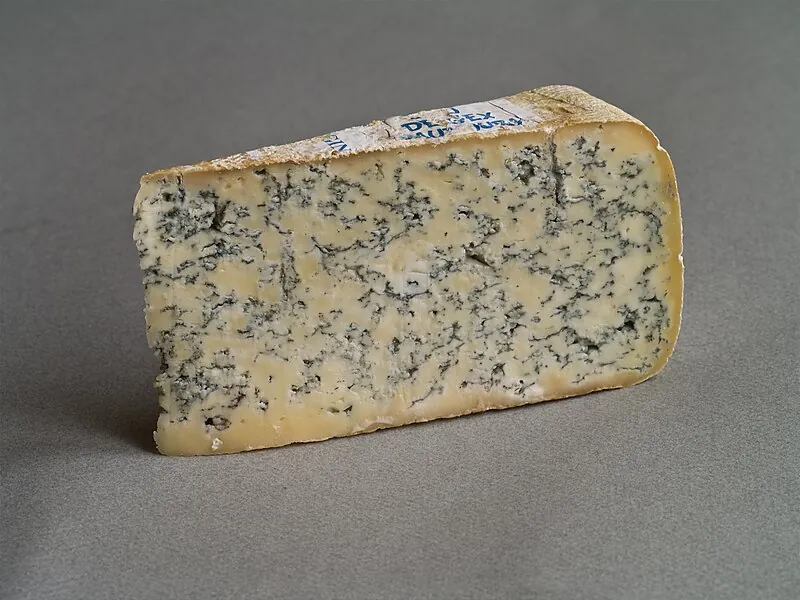
After the cheese is formed and has been salted, cheesemakers use long stainless steel needles (typically 2 to 3mm in diameter) to pierce the wheel in a regular pattern, often 50 to 80 times per wheel. These channels allow oxygen to penetrate from the surface into the interior of the cheese. Penicillium roqueforti spores, introduced either into the milk during production or via the needle channels, germinate in these oxygen-rich pathways and grow outward along the channels over the weeks of ageing. The result is the characteristic irregular network of blue-green veins that traces the needle paths through the paste.
The veins are not just visual. As the mould grows, it produces lipases and proteases: enzymes that break down fats and proteins. This enzymatic activity is responsible for the peppery heat, the pungent aroma, and the intensely complex flavour that distinguishes blue cheese from other styles. The longer the cheese ages and the more active the mould, the more pronounced these qualities become.
Roquefort AOP: The King of Blues
Roquefort is often called the king of French cheese, and its history is extraordinary. Made from the raw milk of Lacaune sheep in the southern Massif Central, it is aged exclusively in the natural caves of Mont Combalou near the village of Roquefort-sur-Soulzon in Aveyron. These limestone caves maintain a constant temperature of 8 to 10°C and 95% humidity year-round, with natural ventilation through fissures called "fleurines" that pull air through the caves and create ideal conditions for Penicillium roqueforti growth.
The cheese received what may be the first recorded cheese AOC (Appellation d'Origine Contrôlée) protection in French history: a royal charter of 1411 granted by Charles VI prohibited other villages from selling their cheese under the Roquefort name. Today Roquefort carries both AOP status within France and PDO status within the EU.
Only seven producers are licensed to make Roquefort. The most prominent are Société (which produces the majority of all Roquefort and sells under the Société brand in many export markets), Gabriel Coulet, and Papillon. The cheese weighs 2.5kg per wheel and is aged for a minimum of three months. The flavour is sharp, salty, intensely savoury, and slightly spicy with a creamy paste that is moist and spreadable. Roquefort has one of the highest sodium contents of any major cheese: approximately 1,900mg of sodium per 100g.
Stilton PDO: The British Blue
Stilton is Britain's most celebrated cheese. Its PDO specifies that it can only be produced in three English counties: Leicestershire, Derbyshire, and Nottinghamshire. Despite its name, it cannot be produced in the village of Stilton itself, which is in Cambridgeshire. The name comes from the historical role of Stilton as a coaching stop on the Great North Road where the cheese was sold in the 18th century, not from its place of production.
Stilton is made from pasteurised cow's milk. The wheels are larger than Roquefort (approximately 8kg), cylindrical, and aged for a minimum of nine weeks. The rind is natural and rough, ranging from pale beige to a darker greyish-orange with age. The paste is ivory-coloured, becoming more golden close to the rind, with irregular blue-green veins. The flavour is considerably milder than Roquefort: less salty, with a more pronounced buttery and mushroomy base and a gentle peppery heat. It crumbles more readily than Roquefort and becomes more crumbly as it ages.
Six dairies are licensed to produce Stilton: Colston Bassett, Cropwell Bishop, Long Clawson, Tuxford and Tebbutt, Hartington (now part of a larger group), and Websters. Colston Bassett is widely considered to produce the finest artisan Stilton, hand-ladling the curd and using traditional starter cultures.
White Stilton is a separate product: unaged, un-pierced, mild, and often sold with added fruits. It does not carry the same PDO as Blue Stilton and is a different cheese.
Gorgonzola DOP: Italy's Ancient Blue
Gorgonzola is one of the world's oldest blue cheeses, with production in the Lombardy region of Italy documented since at least the 9th century. Some Italian historians claim production began in 879 AD in the town of Gorgonzola, near Milan, though the first secure documentary reference is from the 11th century.
The cheese carries DOP (Denominazione di Origine Protetta) status and is produced across a defined area of Lombardy and Piedmont. It comes in two distinct styles:
- Gorgonzola Dolce: Young, creamy, and spreadable. Aged for approximately 2 to 3 months. The veins are pale blue-green and the paste is moist and almost liquid near the centre. The flavour is mild, sweet, and buttery, with only a gentle sharpness. An excellent entry point for people new to blue cheese.
- Gorgonzola Piccante (or Naturale): Aged for 6 to 12 months. Firmer, more crumbly, with darker, more extensive veining and a far more powerful flavour: sharp, peppery, and intensely savoury. Often described as the closest Italian equivalent to Roquefort in intensity.
Approximately 4.5 million wheels of Gorgonzola are produced annually, making it one of the highest-production PDO cheeses in Italy. The Consorzio per la Tutela del Formaggio Gorgonzola oversees production and wraps all certified wheels in foil stamped with the letter "g."
Other Notable Blue Cheeses
Cashel Blue (Ireland): Produced since 1984 by the Grubb family in County Tipperary, Cashel Blue is made from pasteurised cow's milk and aged for 10 to 12 weeks. The flavour is mild, creamy, and slightly sweet, with less salt and sharpness than the three continental classics. It has gained considerable recognition in the UK and Irish market and is an ideal choice for those who find Stilton or Roquefort too intense.
Cabrales (Spain): An intensely flavoured blue from Asturias, made from a mixture of cow's, sheep's, and goat's milks and aged in natural limestone caves in the Picos de Europa mountains. Its flavour is among the strongest of any blue cheese: sharp, spicy, and deeply pungent. It carries DOP status.
Bleu d'Auvergne AOP (France): A good everyday blue made from cow's milk in the Auvergne region. More accessible than Roquefort and reasonably priced, it has a creamy texture and moderate sharpness.
Histamine Content and Tolerance
Blue cheese is among the foods highest in histamine, a biogenic amine produced by the bacterial and mould activity during ageing. People with histamine intolerance (an impaired ability to break down dietary histamine due to reduced diamine oxidase enzyme activity) may experience headaches, skin flushing, nasal congestion, or digestive discomfort after eating aged blue cheese. This is not an allergy to dairy per se but a sensitivity to histamine that affects an estimated 1 to 3% of the population, though symptoms exist on a spectrum. Younger, milder blue cheeses such as Gorgonzola Dolce typically contain less histamine than intensely aged varieties such as Roquefort Piccante.
Cooking with Blue Cheese
Steak sauce: Melt 50g of Gorgonzola Dolce or Stilton in a small saucepan with 100ml of double cream over gentle heat. Add a teaspoon of Worcestershire sauce and a pinch of black pepper. Stir until smooth and pour over a rested steak. The fat and acid in the cream tame the sharpness of the cheese and produce a rich, complex sauce that takes two minutes to make.
Pasta: Blue cheese melts into pasta sauces beautifully. Gorgonzola Dolce with rigatoni, toasted walnuts, a little butter, and fresh sage is a classic northern Italian combination. Stilton works similarly with penne, pear, and rocket.
Walnut and blue cheese salad: Roquefort, bitter endive or radicchio, toasted walnuts, and a honey-mustard vinaigrette is one of the great French bistro salads. The bitterness of the endive cuts the fat of the cheese; the sweetness of the dressing modulates the saltiness.
Blue cheese dressing: Crumble 80g of Stilton or a mild blue into 150ml of mayonnaise, 75ml of sour cream, one tablespoon of white wine vinegar, half a teaspoon of garlic powder, and salt and pepper. Thin with a tablespoon of milk to pouring consistency. This keeps refrigerated for five days.
Wine Pairing
The sweetness-for-salt pairing principle applies consistently to blue cheese. The salt and sharpness of the cheese is balanced by the residual sugar and acidity of sweet wines.
- Roquefort: Sauternes is the textbook pairing, established over centuries in France. The honeyed sweetness of botrytised Semillon is extraordinary against the salt and intensity of Roquefort. Jurançon Moelleux is a more affordable alternative.
- Stilton: Tawny Port, particularly a 20-year-old Tawny, is the classic British Christmas combination. The dried-fruit richness and gentle tannins complement the creamy, crumbly cheese perfectly.
- Gorgonzola Dolce: Moscato d'Asti or a late-harvest Riesling. The light sweetness and low alcohol suit the mild, creamy character of the Dolce style.
- Aged beer: a barleywine, a Trappist quadrupel, or a well-hopped Imperial Stout pairs exceptionally well with all blue cheeses if wine is not available.
Storage: Foil, Not Plastic
Wrap blue cheese in aluminium foil rather than cling film. Cling film creates an airtight environment that encourages ammonia build-up and slimy rind development. Foil allows a small amount of air circulation while protecting the cut surfaces. Store in the warmest part of the refrigerator, ideally the vegetable drawer, where temperatures are typically 4 to 6°C rather than the 1 to 3°C of the coldest shelf.
Blue cheese stored this way keeps for two to three weeks after purchase. Some intensely aged varieties, particularly Roquefort and Cabrales, keep for longer because their high salt content acts as a preservative.
The Rind Question
Blue cheeses rarely have a true rind in the way that brie or Cheddar does. What appears to be a rind is usually a natural outer crust of dried paste and surface mould. On Stilton, the rough brownish outer crust is typically cut away before serving: it has a bitter, strongly ammoniated flavour and is not pleasant to eat. On Roquefort, the thin outer layer is also usually discarded. On Gorgonzola, the foil wrapping means there is no real rind at all, and the outer paste is edible. When in doubt, taste a small piece of the outer layer: if it is bitter or harsh, remove it; if it tastes like the rest of the cheese, eat it.
Related: How to Build the Perfect Cheese Board | Brie and Camembert: France's Greatest Soft Cheeses Explained