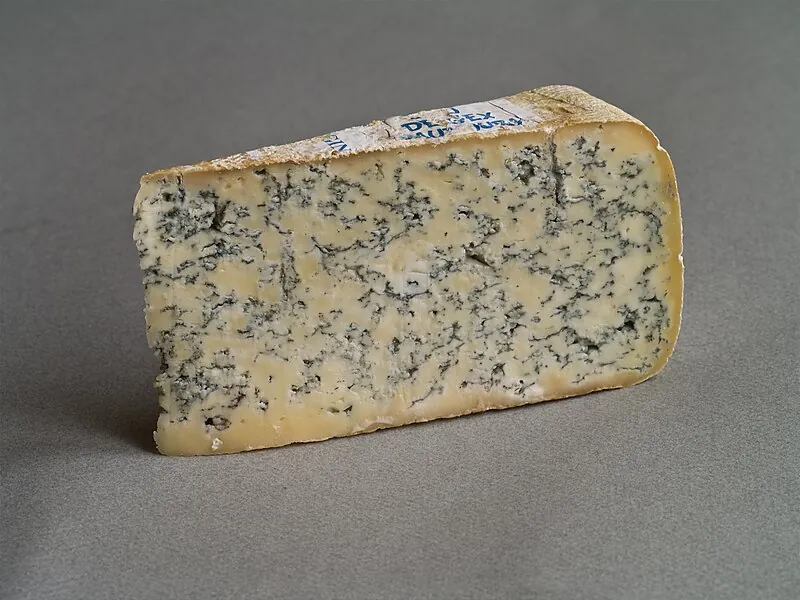
There are roughly a dozen producers of Roquefort. They range from the giant Société Roquefort, which controls about 70% of annual production, to small family cellars aging a few hundred wheels per year. All of them are located in the same village: Roquefort-sur-Soulzon, population approximately 700, in the southern Massif Central of France. The law requires it. Under the Roquefort AOC, which was the first appellation d'origine contrôlée ever granted for a food product in France, in 1925, the cheese must be aged exclusively in the natural caves of the Combalou plateau. No other location is legally, biologically, or geologically capable of replicating what happens inside those caves. This is not marketing. It is a convergence of Triassic limestone geology, a specific fungal species with unusual metabolic properties, and a microclimate produced by cracks in the rock that no engineer has successfully reproduced at scale.
The Combalou Plateau and the Geology of Flavor
The Combalou is a limestone mesa approximately 2 kilometers long and 300 meters high, rising above the Soulzon river valley. Its geological character derives from a partial collapse that occurred approximately 700,000 years ago, when a significant portion of the plateau's interior fractured. The result is a honeycomb of interconnected galleries, natural caves, and fault lines running through the rock. Where these fault lines reach the exterior, they create openings called fleurines (from the Occitan fleurina, meaning ventilation gap). There are between 10 and 20 significant fleurines active at any given time, and their precise location and aperture are carefully monitored by the cave masters.
The fleurines drive a continuous, gravity-fed air exchange system that operates independently of external weather. Cold, humid air from the deep cave interior flows outward through the fleurines when the external air is warmer (in summer), and warm external air is drawn in during winter. The result is a cave temperature that stabilizes at 9 to 11°C year-round, with relative humidity consistently between 95 and 99%. These conditions cannot be achieved by mechanical refrigeration with the same microbiological richness, because air conditioning systems filter and sterilize the air they circulate. The fleurine air carries with it a biological payload: suspended spores, mineral particles from the limestone, and volatile compounds from the aging cheese that have been cycling through these caves for centuries.
The rock itself contributes. Combalou limestone contains significant quantities of calcium carbonate, magnesium, and trace minerals that the cave air absorbs. Analyses conducted by the Institut National de la Recherche Agronomique (INRAE) and its predecessor INRA have found mineral profiles in the cave biofilm communities that differ substantially from those in artificially constructed cheese caves attempting to replicate Roquefort conditions.
Penicillium Roqueforti: A Fungus with a Specific Job
Penicillium roqueforti is the mold responsible for the blue-green veining and the characteristic flavor of Roquefort, as well as Gorgonzola, Stilton, and most other blue cheeses. However, P. roqueforti is not a single homogeneous organism. It is a species complex with multiple genetically distinct populations, and the strains isolated from the Combalou caves have metabolic properties that differ measurably from those used in industrial blue cheese production.
The fungus produces three main classes of flavor compounds in cheese. Methylketones (primarily 2-heptanone and 2-nonanone) are produced when the mold metabolizes milk fat through a process called beta-oxidation: the fatty acids are partially broken down, and the terminal carbon is released as a methyl ketone rather than being fully oxidized. These compounds are directly responsible for the sharp, peppery intensity associated with well-made Roquefort. Secondary alcohols, particularly 2-heptanol, are reduced from the methylketones by P. roqueforti enzymes and add softer, more floral notes. Sesquiterpenes, a class of hydrocarbon compounds, contribute earthy and mushroom-like undertones that vary by strain.
The Combalou strains of P. roqueforti are notable for particularly high lipase activity, meaning they break down fat at an accelerated rate compared to commercial strains selected for milder industrial blue cheeses. A 2017 study in International Dairy Journal by Dagnas and colleagues at the Université de Bourgogne characterized the enzymatic profiles of cave-isolated versus industrial P. roqueforti strains and found significantly higher levels of extracellular lipase production in the cave population, which the authors proposed as a partial explanation for why Roquefort's flavor is more intense at equivalent aging times than most other blue cheeses.
The 2023 INRAE Study: A Microbial Ecology of the Cave Rind
In 2023, researchers at INRAE's Unité de Recherche Fromagère in Aurillac, in collaboration with colleagues at the Université Clermont Auvergne, published a detailed metagenomic analysis of the microbial communities present on the rinds of Roquefort wheels at various stages of aging. The study, published in Food Microbiology, sequenced the bacterial and fungal DNA present on wheel surfaces at 14, 30, 60, and 90 days of cave aging, comparing wheels aged in the traditional natural caves against control wheels aged in temperature- and humidity-matched artificial chambers circulating HEPA-filtered air.
The findings were detailed and significant for understanding what the cave environment specifically contributes. Wheels aged in the natural caves showed a substantially more diverse bacterial community throughout the maturation period. At 30 days, cave-aged wheels carried detectable populations of more than 40 bacterial genera compared with 12 to 15 in the artificial environment. The dominant organisms in both conditions included Brevibacterium linens (responsible for sulfurous, ammoniacal rind aromas), Corynebacterium species, and Staphylococcus equorum (a non-pathogenic salt-tolerant species that contributes proteolytic activity). However, cave-aged wheels additionally carried significant populations of Leuconostoc mesenteroides, Lactococcus garvieae, and several uncharacterized Psychrobacter species that were effectively absent in the artificially aged controls.
The INRAE researchers proposed that this greater microbial diversity creates what they called a "proteolytic cascade": a sequential breakdown of casein proteins by multiple organisms, each exploiting the metabolic byproducts left by the previous organism in the sequence. This cascade produces a broader range of free amino acids and bioactive peptides in the cave-aged cheese, which in turn supports the development of more complex flavor. Wheels aged artificially showed a simpler amino acid profile and were rated significantly lower on flavor complexity by the study's trained sensory panel.
The Spore Ecology of the Fleurines
One of the most practically important questions the INRAE study addressed is where the diverse microbial community comes from. Cheese makers do not inoculate wheels with 40+ bacterial genera. The Roquefort AOC requires only that the mold used be P. roqueforti. The answer revealed by the metagenomic data is that the cave air itself is the inoculum.
Air samples taken at the fleurine openings contained the spores and cells of all the bacterial genera subsequently found on cave-aged rind communities. The fleurine air is not merely temperature-controlled; it is biologically laden. The Combalou caves have been used to age cheese continuously for at least 1,200 years, based on the documentary record (Charlemagne is reported to have tasted Roquefort at the Abbey of Vabres in 778 CE, though this account survives in a much later chronicle). Centuries of cheese aging have built up a cave microbiome that is now self-sustaining. The biofilm on the cave walls contains reserves of the key organisms that are continuously released into the cave air and redeposited on fresh cheese.
This is why the Roquefort appellation's geographic requirement is not merely political or commercial protectionism. The organisms that make Roquefort what it is are residents of these specific caves, not of any cheese cave of the right temperature and humidity. The 2023 INRAE paper explicitly states that the results "support the AOC framework's insistence on cave specificity as having a genuine microbiological, not merely commercial, basis."
The Legal Architecture of Roquefort Protection
The Roquefort AOC is one of the most tightly defined geographical indications in European food law. Its requirements are worth understanding in detail:
- Milk source: The cheese must be made from the raw whole milk of Lacaune ewes, a breed native to the Massif Central, from herds within a defined zone covering parts of Aveyron, Lozère, Gard, Hérault, Aude, and Tarn departments.
- Curdling: Coagulation must use animal rennet. Microbial or vegetable rennet substitutes are prohibited.
- Mold inoculation: P. roqueforti spores must be used. The specification historically required spores cultivated from rye bread baked and left to mold in the caves, though commercial cave-derived cultures are now standard.
- Aging location: Affinage must take place exclusively in the natural caves of the Combalou in the commune of Roquefort-sur-Soulzon. A minimum of 14 days in the cave is required, though most wheels age for 3 months or longer.
- Needle-piercing: Wheels must be pierced with needles before cave entry to create air channels through which P. roqueforti can grow. The pattern and timing of piercing is specified in the cahier des charges, the detailed production specification.
The European Court of Justice upheld the geographic exclusivity of Roquefort production in a 1999 ruling that clarified the legal force of PDO designations under EU food law. A 2005 trade dispute involving the US, which had not ratified the relevant bilateral agreement, led to a compromise arrangement under which Roquefort is sold in the US under its own name with geographic origin clearly labeled, while other American blue cheeses cannot use the Roquefort name.
Eating Roquefort: What Cave Aging Tastes Like
Understanding the science makes the tasting experience more precise. A well-aged Roquefort, typically between 3 and 5 months old, should show the following characteristics that are directly traceable to the biology described above:
The paste should be ivory-white, dense, and moist, with blue-green veining following the needle channels. The veins themselves are intensely aromatic, carrying the methylketone signature of active P. roqueforti metabolism. Tasting directly from a vein should produce a sharp, peppery, almost metallic sensation. The surrounding paste should be creamier and milder, with a distinctive lanolin-like quality from Lacaune sheep milk fat, which has a different short-chain fatty acid composition from cow's milk. The finish should be long, salty (Roquefort is heavily brined), and complex, with the floral secondary alcohol notes appearing 30 to 60 seconds after the initial sharp impact.
Société Roquefort, the dominant producer, makes a consistent product well-suited to first encounters. Le Papillon and Carles are smaller producers whose wheels receive longer cave time and show more dramatic flavor variation. Gabriel Coulet, a mid-sized producer, is particularly well-regarded for consistency at artisan quality levels. All seven licensed producers (Société, Le Papillon, Carles, Gabriel Coulet, Vernières, Combes, and Fromageries Occitanes) use the same caves, same milk, and same mold, but differ in aging protocols, rind treatment, and the specific cave galleries they use.
The village of Roquefort-sur-Soulzon receives approximately 350,000 visitors per year. Most of the cave facilities offer guided tours that descend into the active aging galleries. Standing in a cave where the air temperature is 10°C, the humidity condenses on your glasses, and the ceiling is covered in a velvet of cave biofilm, while watching workers turn and inspect wheels on the wooden slatted shelves called lauses, is one of the more viscerally educational food experiences available to a traveler. The science is present and visible in a way that few agricultural foods permit.
Related: The Science of Cheese Aging and Affinage | Exotic and Pungent Cheeses from Around the World