Brie and Camembert are the most recognisable names in French cheese, yet most people have never tasted the real versions. The brie sold in most supermarkets worldwide bears little resemblance to Brie de Meaux AOP, and the foil-wrapped wedges of "Camembert" imported from Denmark or Germany are a different product entirely from Camembert de Normandie AOP. Understanding the difference between the authentic and the industrial is the first step toward getting genuine pleasure from these extraordinary cheeses.
Brie: The Three Versions You Need to Know
Two bries carry AOP (Appellation d'Origine Protégée) status in France, meaning their production is legally tied to specific places and methods.
Brie de Meaux AOP is made in the Seine-et-Marne department east of Paris, in a region historically known as the "Île-de-France." It is a large cheese: the standard wheel is 36 to 37cm in diameter and weighs 2.5 to 3kg. Made from raw cow's milk, it is pressed into moulds by hand using a special perforated ladle (pelle à brie), then aged for a minimum of four weeks. The flavour develops from mild and milky when young to deeply complex, with notes of mushroom, hazelnut, and ammonia as it matures. Brie de Meaux has been made since at least the 8th century; Charlemagne is said to have encountered it at the monastery of Rueil-en-Brie around 774 AD.
Brie de Melun AOP is smaller (27cm diameter, around 1.5kg), made from raw milk, and uses a different production method: lactic-acid bacteria rather than rennet as the primary coagulant, giving it a longer set time of 18 hours or more. This produces a more acidic, more pungent, and more assertively flavoured cheese than Brie de Meaux. It is aged for a minimum of four weeks but is typically sold older than Brie de Meaux. Brie de Melun is considered by many French cheesemakers to be the ancestor of all brie styles.
Supermarket brie (labelled simply "brie" with no geographic indication) is made from pasteurised milk, often in large industrial facilities, and is stabilised to prevent it from ripening further during its shelf life. This stabilisation, achieved through specific cultures and temperature controls during production, means supermarket brie never develops the runny interior, complex flavour, or genuine aroma of a properly ripened AOP brie. It is a convenient product but a different food.
Camembert: AOP vs Industrial
Camembert de Normandie AOP is one of the most precisely defined cheeses in the world. The rules are strict: it must be made in Normandy, from raw (unpasteurised) milk from Normande cattle, and the curd must be hand-ladled into the moulds in five separate layers over a period of at least 40 minutes. Each wheel weighs exactly 250g and measures 10.5 to 11cm in diameter. The cheese is aged for a minimum of 21 days on straw mats. It is sold in a round wooden box (originally designed in 1890 by a Normandy engineer specifically to ship the cheese to Paris without damage).
The hand-ladling in five layers is not a formality. It produces a softer, more delicate curd structure than machine-moulding and contributes to the distinctive texture of the finished cheese: an interior that becomes almost liquid at perfect ripeness.
Industrial Camembert, which constitutes the vast majority of global Camembert production and is what virtually all non-specialist retailers sell, is made from pasteurised milk using mechanised moulding. It is a more uniform, less complex, and less perishable product. It melts adequately and is not unpleasant, but it lacks the depth and runny richness of the genuine article.
Camembert is associated with Marie Harel, a farmer from the village of Camembert in Normandy. Tradition holds that she developed the cheese in 1791, aided by a priest from Brie. The first written record of the cheese by that name dates to around 1790.
The White Rind: Penicillium Camemberti
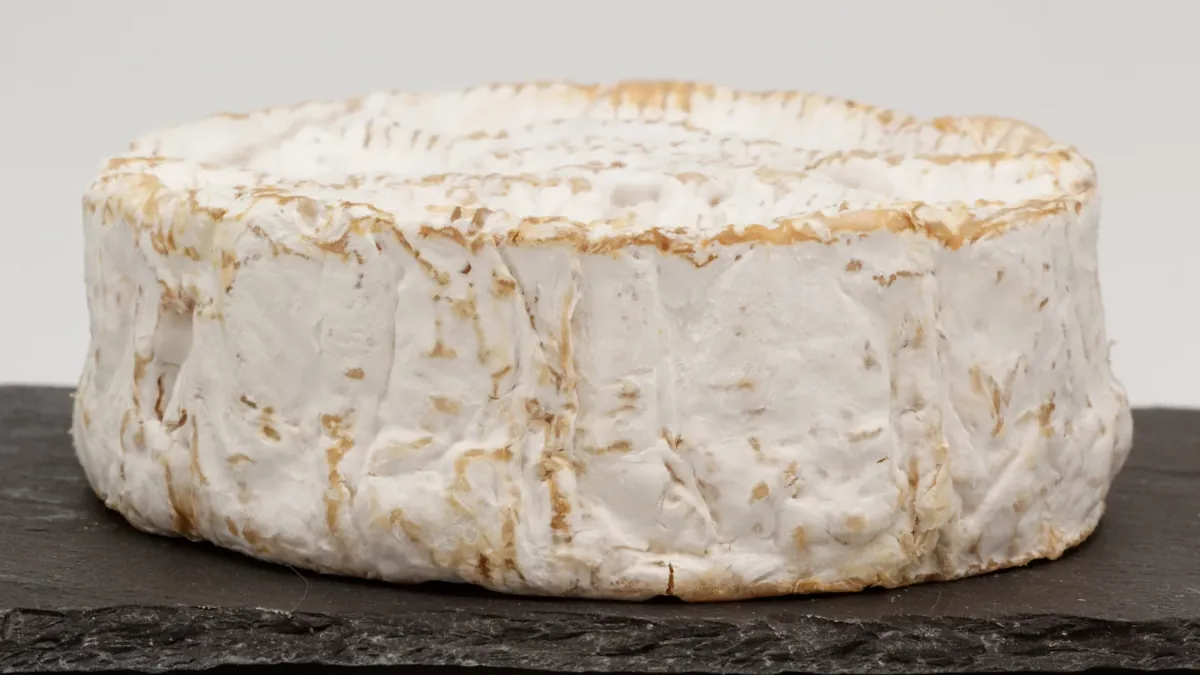
The white, downy rind on both brie and Camembert is a bloom of Penicillium camemberti, a mould species used deliberately in production. After the fresh cheese is formed, the wheels are sprayed or dipped in a solution containing P. camemberti spores, then aged in humidity-controlled cellars where the mould colonises the surface within days.
The rind does several things. It protects the interior from undesirable contamination. As it matures, it produces proteolytic enzymes that break down proteins in the paste, softening the interior from the outside inward. This is why a perfectly ripe brie or Camembert is liquid near the rind while the centre (called the "heart" or coeur) may remain firmer. The rind also contributes flavour compounds, including earthy, mushroomy, and ammonia notes that intensify as the cheese ages.
The rind is edible and, in properly ripened cheese, an important part of the flavour. People who systematically remove it are discarding much of what makes the cheese interesting.
How to Tell When the Cheese Is Ripe
The simplest test is the same as judging a ripe avocado. Press the top of the cheese gently with one finger. The cheese should give slightly and spring back slowly. If it feels firm throughout, it needs more time. If it feels liquid under the rind in the centre, it may be past peak, though many people prefer this very ripe state.
Colour is also a guide: the rind of a ripe Camembert de Normandie takes on reddish-orange patches caused by Brevibacterium linens growth alongside the Penicillium bloom. Industrial Camembert typically has a pure white rind, partly because it never reaches the same ripeness stage.
Smell is the final indicator. A ripe, real brie or Camembert smells mushroomy, earthy, and slightly pungent, but not sharply of ammonia. Strong ammonia smell usually indicates overripeness, though some eaters enjoy cheese at this stage paired with sweet accompaniments.
Serving
Both brie and Camembert must be served at room temperature. Cold suppresses the aromas and firms the paste, eliminating the textural and flavour qualities that make the cheese worth buying. Remove the cheese from the refrigerator at least 45 minutes before serving, and ideally one to one and a half hours in a warm room.
On a cheese board, serve with sliced baguette (not crackers, which compete), fruit such as grapes, pear, or fresh fig, and something sweet: a good quince paste or a drizzle of acacia honey. Walnuts pair naturally with both cheeses.
Never cut the nose off a brie wedge (the pointed tip). The rind-to-paste ratio at the nose is different from the rest of the wedge, and cutting it off deprives someone of that portion. Slice from the pointed end outward in thin wedges.
Baked Camembert
Baked Camembert has become one of the most popular dinner-party starters in Britain and much of Europe. The method is simple: score the top of the rind in a crosshatch pattern, add toppings, and bake in the oven at 180°C (fan) for 15 to 20 minutes until the interior is fully melted and bubbling.
The best toppings:
- Honey and walnuts: The classic. Drizzle a tablespoon of dark honey over the scored rind and press in walnut halves before baking. Add a few thyme leaves for fragrance.
- Garlic and rosemary: Insert slivers of garlic into the scored rind along with small sprigs of fresh rosemary. Drizzle with olive oil. A more savoury result than the honey version.
- Cranberry sauce: A seasonal favourite, particularly at Christmas. Spoon cranberry sauce over the top after the last five minutes of baking rather than at the start, to prevent burning.
Use the wooden box the Camembert comes in as the baking vessel (remove any paper lining and foil). If the box is absent, place the cheese on a small baking tray lined with foil, curling the foil up around the sides to hold the cheese in place as it softens. Serve with bread, apple slices, or crudités for dipping.
Pairing
Classic French pairings for brie and Camembert include Champagne and sparkling Crémant d'Alsace, where the acidity and bubbles cut through the richness. Beaujolais, particularly Fleurie or Morgon, works well: the light, fruity red doesn't overwhelm the delicate paste. Dry Norman cider is the traditional regional pairing for Camembert and is arguably the most complementary of all: the apple acidity and slight tannin in aged cider (such as a Breton or Norman cidre bouché) is a natural counterpart to the funky, fatty cheese.
Storage and the No-Plastic-Wrap Rule
Plastic wrap is the enemy of soft-ripened cheese. It traps moisture against the rind, encouraging ammonia build-up and causing the rind to become slimy. Wrap brie and Camembert in wax paper or cheese paper, which allows the rind to breathe, and store in the least cold part of the refrigerator, ideally in the vegetable drawer. Eat within three to five days of opening for best flavour.
Freezing destroys the texture of soft-ripened cheese. The paste becomes grainy and watery upon thawing, and the rind deteriorates. Brie and Camembert should not be frozen.
Related: How to Build the Perfect Cheese Board | Blue Cheese: Roquefort, Stilton, Gorgonzola, and the World's Greatest Mould-Ripened Cheeses