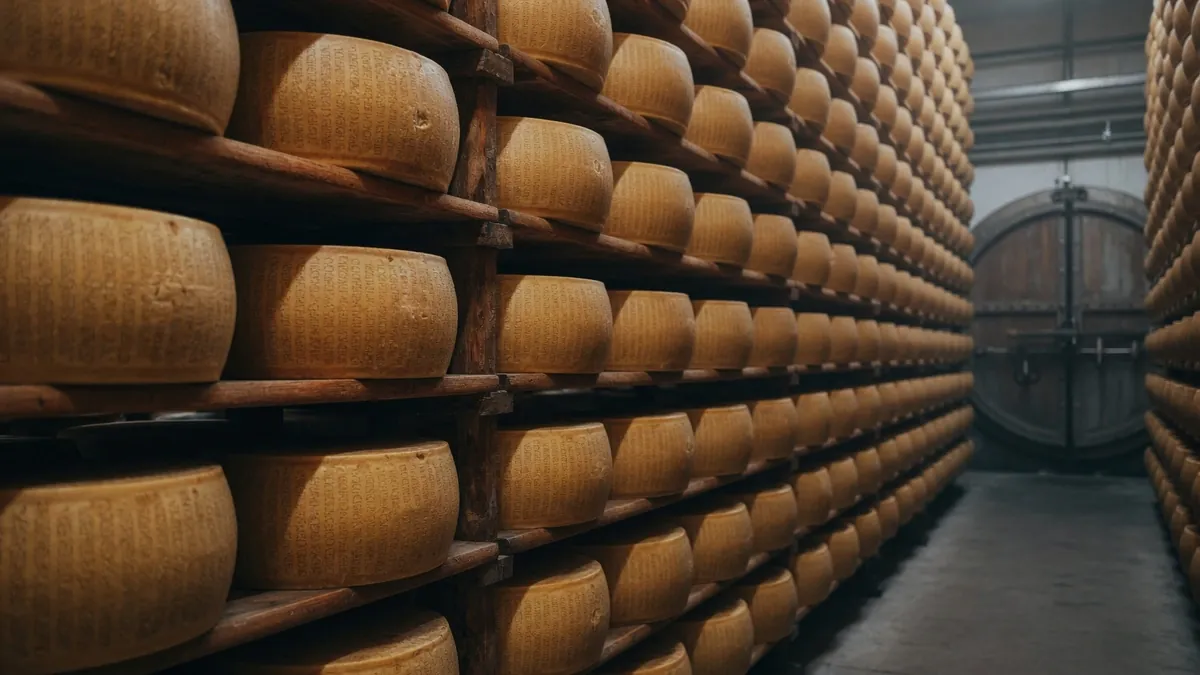
Cheese aging is one of the most complex food transformations in the human culinary repertoire. What begins as a fresh, mild curd becomes, over months or years, a biochemically rich substance containing hundreds of flavour compounds that no fresh dairy product could produce. The people who manage this transformation professionally are called affineurs (from the French affiner, meaning to refine), and their work combines microbiology, materials science, and sensory judgment in a practice that takes years to master. Understanding what happens during aging, in terms of the specific microorganisms, chemical reactions, and environmental conditions involved, explains why aged cheeses taste the way they do and why the environment of a natural cave cannot be fully replicated in an industrial facility.
The Affineur: A Specialist in Managed Decay
An affineur purchases young cheese from caseifici (producers) and takes on the maturation process, selling the finished aged cheese to retailers and wholesalers. This division of labour has existed in France and Switzerland since at least the 18th century and allows small-scale cheesemakers to focus on production while specialists with larger, purpose-built facilities handle the long, skill-intensive aging process.
The affineur's primary tools are temperature, humidity, airflow, and regular physical attention to the cheese, including turning (to ensure even moisture distribution and prevent the bottom from becoming waterlogged), brushing (to manage surface mould growth), and washing (in brine, wine, beer, or spirits to develop specific rind flora). These interventions are not merely cosmetic; they determine which microorganisms colonise the surface and, through their metabolic activity, shape the interior chemistry of the cheese.
The most celebrated European affineurs include Hervé Mons (Loire Valley, France, who supplies washed-rind and goat cheeses to Michelin-starred restaurants across Europe), Neal's Yard Dairy (London, which ages British farmhouse cheeses in its own cellars before retail), and Antonie Kramer (Switzerland, specialising in mountain cheeses).
The Three Aging Environments
Natural Caves
Natural caves provide conditions that are extremely difficult to replicate artificially: constant temperature, high natural humidity, and a stable ecosystem of microorganisms that have evolved specifically in that environment over centuries. The Combalou cave system near Roquefort-sur-Soulzon in the Aveyron region of southern France is the most famous example. These caves, formed by geological faults in the Combalou plateau, maintain a year-round temperature of 6 to 8°C and a relative humidity of approximately 95 to 98 percent. Crucially, the caves' rock is naturally inhabited by Penicillium roqueforti, the blue-green mould that creates the characteristic veining of Roquefort cheese. The local PDO rules for Roquefort require that the cheese be aged exclusively in these caves, ensuring that the specific Combalou strain of P. roqueforti contributes to every wheel.
The Cellars of Affineurs in Beaufort, the caves of Salers, and the chalk caves of Époisses production facilities all provide similarly unique microbial environments. The point is not merely temperature control but biological diversity: natural caves contain hundreds of bacterial and fungal species that interact with the cheese paste and rind in ways that purpose-built refrigerated cellars cannot fully reproduce.
Purpose-Built Cellars
Industrial and semi-artisan aging facilities use controlled-environment cellars with programmable temperature, humidity, and airflow. Humidity is maintained at 85 to 98 percent relative humidity for soft and semi-soft cheeses (lower humidity causes cracking and excessive drying), and at 70 to 80 percent for hard cheeses like Cheddar and aged Gouda where controlled moisture loss is part of the flavor development. These facilities can replicate many of the conditions of natural caves but lack the site-specific microbial populations that make cave-aged cheeses distinctive.
Washed-Rind Environments
Washed-rind cheeses are aged in environments that specifically encourage the growth of Brevibacterium linens (B. linens), a bacterium that thrives on the salty, moist surface created by repeated washings with brine. B. linens is responsible for the orange-to-red-brown rind colour and the extraordinarily pungent aroma of washed-rind cheeses including Époisses, Munster, Taleggio, and Limburger. The smell of these cheeses comes specifically from the sulphur compounds produced as B. linens metabolises amino acids in the rind. The interior of washed-rind cheeses is typically much milder than the exterior suggests.
Rind Types and Their Microbiology
The rind of a cheese is not merely a protective shell; it is an active microbial community that profoundly influences the interior through enzyme and flavour compound transfer.
Natural Rind
Natural rinds form when the cheese surface is left to develop its own microbial community from the environment. The specific yeasts, moulds, and bacteria that colonise it depend on the ambient air, the aging room's existing microbiome, and the cheese's moisture content. Natural-rind cheeses include Comté, Beaufort, and many traditional English territorial cheeses (Cheddar, Cheshire, Red Leicester). Their rinds are typically grey-brown and can be covered in a range of moulds, some of which are scraped or brushed off during aging to manage the flora.
Bloomy Rind
Bloomy rinds are created by spraying the young cheese with a solution of Penicillium camemberti or Penicillium candidum spores. These moulds grow as a white, fluffy layer that gradually compacts into the characteristic soft, downy rind of Camembert, Brie, and Coulommiers. The mould produces proteolytic enzymes that soften the cheese from the outside inward, which is why a perfectly ripe Camembert is runny just beneath the rind and firmer at the centre. An underripe Camembert is chalky throughout; an overripe one becomes ammoniated and unpleasant as the breakdown process exceeds the ideal window.
Blue Rind
Blue cheeses develop their internal veining through a process called needling: steel needles are pushed through the young cheese to create air channels, through which P. roqueforti or related blue Penicillium species grow. The blue-green mould requires oxygen, which is why it grows only where the needles have opened channels to the interior, rather than developing uniformly throughout the paste. The lipolytic activity of P. roqueforti (breaking down fats into free fatty acids) is responsible for the sharp, pungent, complex flavour of Roquefort, Gorgonzola, and Stilton.
The Chemistry of Aging: Proteolysis, Lipolysis, and Glycolysis
Proteolysis
Proteolysis is the enzymatic breakdown of casein proteins into progressively smaller peptides and then into individual amino acids. It is the single most important chemical process in cheese aging, responsible for the textural softening of semi-soft cheeses, the development of complex savoury flavour compounds, and the formation of tyrosine crystals. These crystals, visible as white specks in aged Parmigiano-Reggiano, aged Gouda, and long-aged Cheddar, are not a defect; they are a marker of advanced proteolysis and are associated with the most intensely flavoured, most sought-after examples of these cheeses. The enzymes responsible for proteolysis come from three sources: residual rennet in the curd, naturally present enzymes in the milk, and the metabolic activity of bacteria and moulds on and in the cheese.
Lipolysis
Lipolysis is the breakdown of milk fats into free fatty acids. Short-chain fatty acids produced by lipolysis contribute sharp, tangy, and sometimes rancid notes to aged cheeses, particularly blue cheeses and washed-rind varieties where lipase-rich moulds and bacteria are active on or in the paste. In aged hard cheeses like Parmigiano-Reggiano, controlled lipolysis adds depth and complexity to the umami character without producing the sharp fatty notes of more aggressively lipolysed styles.
Glycolysis
Freshly made cheese contains residual lactose that was not fully fermented during primary production. During the early weeks of aging, the starter bacteria and natural cheese microflora continue to ferment this lactose into lactic acid. In most aged cheeses, the lactose is fully consumed within the first month, which is why aged hard cheeses are typically safe for mildly lactose-intolerant individuals: there is essentially no lactose remaining in a 24-month Parmigiano-Reggiano or an 18-month Cheddar.
Jasper Hill Farm: The American Affinage Model
Jasper Hill Farm in Greensboro Bend, Vermont represents one of the most significant innovations in American artisan cheese infrastructure. The farm operates the Cellars at Jasper Hill, a 22,000-square-foot underground aging facility with seven individually climate-controlled vaults, each designed for a different style of cheese at specific temperature, humidity, and airflow parameters. Crucially, Jasper Hill uses the facility as a shared affineurs' cooperative: small-scale Vermont cheesemakers who lack their own aging space send their young wheels to Jasper Hill, which finishes the aging, develops the rinds, and markets the finished cheese. This model has allowed producers like Cabot Creamery Cooperative to develop the Cabot Clothbound Cheddar into one of the most awarded American artisan cheeses without the capital investment of their own aging infrastructure.
What "Cave-Aged" on a Label Actually Means
"Cave-aged" is not a regulated term in most countries, including the United States, United Kingdom, and Australia. Any producer can use it on a label without legal requirement to demonstrate what type of cave was used, for how long, or what the aging conditions were. Some "cave-aged" labels refer to genuine natural cave environments; others refer to purpose-built underground cellars; and some refer to temperature-controlled rooms that happen to be below ground level. The term conveys a romantic association with traditional methods but provides no guarantee of the specific microbial environment that distinguishes genuinely cave-aged cheese.
A 2019 study published in Cell Host and Microbe by Wolfe, Button, and colleagues at Tufts University examined the rind microbiomes of over 100 cheese varieties from natural cave environments across France, Italy, and the United States. The study identified hundreds of bacterial and fungal species in cave cheese rinds, many of them previously uncatalogued, and found that the microbial community composition was strongly site-specific: the specific combination of species found in Combalou was not found in any other cave, and the combination found in Vermont caves was different again. The authors concluded that the site-specific microbial ecosystems of natural caves cannot be replicated in industrial environments, providing the first systematic scientific basis for the long-held artisan belief that cave environment is irreducibly important to the flavour of cave-aged cheese.
Related: Parmigiano-Reggiano: The King of Cheeses | Blue Cheese: Roquefort, Gorgonzola, and Stilton Compared