Few dining experiences are as convivial as a raclette dinner. Guests sit around a table, load small individual pans with sliced cheese and toppings, slide them under a communal electric grill, and wait for the cheese to bubble and blister before scraping it over boiled potatoes. The meal is slow, social, and deeply satisfying. It has been a staple of Swiss Alpine winters for centuries and has spread throughout Europe, with raclette machines now a common wedding gift in France, Germany, and Scandinavia. In recent years it has gained a following in the United Kingdom, the United States, and Australia, driven partly by social media, partly by the universal appeal of melted cheese.
The Cheese Itself
Raclette is both a method of eating and a specific cheese. The cheese is a semi-hard, washed-rind variety produced in the canton of Valais in southwestern Switzerland, made from raw or pasteurised cow's milk. It is produced in wheels of approximately 6kg with a diameter of around 30cm. The rind is natural, thin, and brownish-orange, produced by regular washing with brine during ageing. The paste is pale ivory, smooth, and supple, with small irregular eyes (holes) and a fat content of around 50% in dry matter.
Valais Raclette (Raclette du Valais) carries AOP (Appellation d'Origine Protégée) status, meaning it must be produced within the canton of Valais using milk from Valais cattle breeds (including the distinctive black-nosed Valais Blacknose sheep, though raclette is a cow's milk cheese). The production area includes the high alpine pastures of the Valais and the valley farms below them.
A wider category of "raclette" cheese, without the Valais AOP designation, is produced throughout Switzerland and in France (particularly in Savoie and the Jura), Germany, and Austria. These are generally good-quality melting cheeses in the same style, though they lack the specific character of the authentic Valais product. French raclette from Savoie, often sold under the name "Raclette de Savoie" or simply "raclette au lait cru" (raw milk raclette), is considered by many to be the closest alternative in quality.
The flavour of raclette cheese is mild, buttery, and faintly floral when cold, with a more pronounced savoury, slightly funky depth when melted, driven by the washed-rind cultures that develop during ageing. It is considerably milder than Époisses (the most intense washed-rind cheese) and much more universally appealing than its pungent raw smell might suggest.
Etymology and History
The word "raclette" comes from the French verb "racler," meaning to scrape. The name describes the defining action of the dish: scraping the melted surface of the cheese onto a plate. This etymology points to the original method, which predates any machine by centuries.
The first written record of the dish is from 1574, in a document from a convent in the canton of Obwalden that describes Swiss Alpine herders eating a food called "Bratchäs" (roasted cheese) while working in the high pastures during summer. The dish was a practical winter and mountain meal: a wheel of cheese held near an open fire or woodstove, with the melted face scraped onto bread or boiled potatoes. The simplicity of the method meant no cooking equipment beyond fire, making it ideal for the conditions of Alpine herding life.
The Swiss government served raclette at the 1964 National Exhibition in Lausanne, which is credited with significantly raising the dish's profile beyond its regional origins and introducing it to a wider national and international audience. By the 1970s and 1980s, electric raclette machines were commercially available and the dish had become a fixture of Swiss and French domestic entertaining.
Traditional Method: Half-Wheel at the Fire
The authentic traditional method uses a half-wheel of raclette cheese placed cut-side facing a heat source, either an open wood fire or a dedicated raclette grill that holds the wheel at an angle toward an infrared heating element. As the exposed face melts, the host (or a designated scraper) uses a flat-bladed knife to scrape the melted layer onto individual plates already loaded with boiled potatoes and accompaniments. The process repeats continuously throughout the meal.
This method produces a slightly different result from the individual-pan machine version. The scraping takes the uppermost melted layer, which has been directly exposed to radiant heat, while the layer immediately below is warm and beginning to melt. This gives a slightly thicker, more varied texture than the uniformly melted cheese from a small machine pan. Many Swiss restaurants and Alpine chalets use this traditional half-wheel method for the full experience.
Half-wheel raclette grills designed for home use are available from brands such as Stöckli (the Swiss market leader), though they are considerably more expensive than tabletop machine versions and require more space.
Raclette Machines: How to Use One
The tabletop electric raclette machine is the domestic standard for home entertaining. The machine consists of a flat upper grill surface (used for grilling meat, vegetables, or bread) and a lower heating element beneath which a row of individual coupelles (small non-stick pans, approximately 12cm long and 8cm wide) can be slid for melting cheese. Most machines accommodate 8 coupelles simultaneously, making them suitable for parties of 6 to 8 people.
The method:
- Preheat the machine for 10 minutes before guests sit down.
- Pre-slice the raclette cheese into 3 to 4mm slices. Each coupelle holds one to two slices depending on the size.
- Load each coupelle with cheese, and optionally a small amount of topping (a slice of tomato, a few slices of mushroom, a pinch of paprika).
- Slide the loaded coupelle under the heating element. The cheese will begin to melt in approximately 3 to 4 minutes, bubbling and beginning to brown at the edges when ready.
- Remove the coupelle and scrape the melted cheese over a portion of boiled potato on the plate using the flat-bladed scraper provided. Return the coupelle for the next round.
The upper grill surface can be used simultaneously to grill thin slices of meat, vegetables, or bread, adding to the communal nature of the meal.
Best Machines: Brand Comparison
Several brands dominate the home raclette machine market:
- Swissmar: A Swiss-Canadian brand widely available in North America. Their Stelvio (8-person) and Saas-Fee models are among the best-regarded in the US market, with good build quality and consistently hot coupelles. The Stelvio retails at approximately $70 to $90 USD.
- Cuisinart: Offers a model (the Cuisinart Electric Raclette) at around $70 to $80 USD that is widely available in US department stores and is reliable for occasional use, though the build quality is slightly less robust than Swissmar.
- Tefal (T-fal): The most widely available brand in Europe, with several models including the Pierrade Raclette (which combines a raclette grill with a hot stone for cooking meat). Available in major UK and French retailers for £50 to £90 depending on the model.
- Stöckli: The premium Swiss brand, used in many Swiss restaurants. More expensive (CHF 200 to 400 for home models) but exceptionally well-built and with superior heat distribution.
The Classic Accompaniments
Raclette is served with a specific and almost invariable set of accompaniments. These are not optional extras: they are structural elements of the meal.
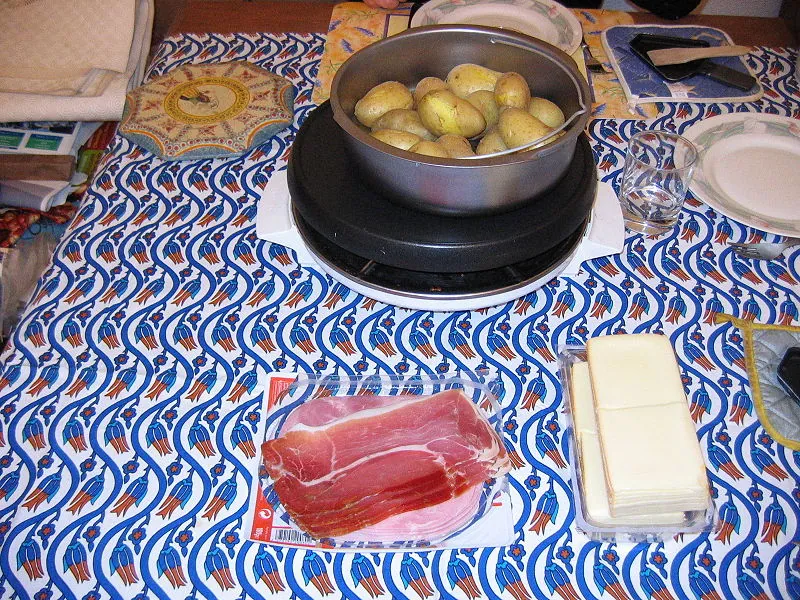
- Boiled new potatoes: Waxy-fleshed, small to medium potatoes boiled in their skins until just cooked through. In Switzerland, the traditional variety is the Bintje or a local alpine potato. In the UK, Charlotte or Jersey Royal potatoes work well. The potato is the base onto which the melted cheese is poured.
- Cornichons: Small, tart French gherkins. Non-negotiable. The sharpness cuts through the fat of the melted cheese and cleanses the palate between servings. Use French cornichons (Maille is the standard brand) rather than large dill pickles.
- Pickled onions (silverskin onions): Small, tart, and crunchy. Serve alongside the cornichons.
- Charcuterie: The traditional Swiss choice is Viande des Grisons (also known as Bündnerfleisch), the air-dried beef from the canton of Graubünden that is one of Switzerland's most prized cured meats. Prosciutto, Jamón Serrano, or a good saucisson sec are excellent substitutes or additions.
- Freshly ground black pepper: Scattered over the cheese just before scraping is a Swiss tradition and lifts the flavour considerably.
Some modern raclette meals add sliced raw vegetables (peppers, courgette, mushrooms) to grill on the upper surface, bread for toasting, or seafood such as prawns. These are not traditional but work well with the format.
Cheese Substitutes When Raclette Is Unavailable
In countries where raclette cheese is not readily available, or for cost reasons, several alternatives melt in a similar way and produce excellent results:
- Gruyère AOP: The closest Swiss alternative. Melts beautifully, slightly nuttier and more complex than raclette. Available in most well-stocked supermarkets internationally.
- Comté AOP (France): Similar melting properties to Gruyère, with a more complex flavour. Excellent choice.
- Appenzeller: Another Swiss cheese with good melting properties. Has a sharper, more herbal flavour due to the brine wash recipe (which includes a secret blend of herbs and wine).
- Taleggio DOP (Italy): A washed-rind cheese from Lombardy that melts even more readily than raclette and has a similar funky, savoury character. Available in most good cheese shops.
How Much to Buy
The standard guidance for a raclette dinner as a main course is 200 to 250g of cheese per person. For a large appetite or a long, leisurely evening meal, 300g per person is safer. If serving other food alongside (charcuterie, bread, salad), 180g per person is usually sufficient.
For eight people, purchase approximately 1.6 to 2kg of cheese. Buy in one large piece or ask the cheesemonger to slice it for you into 3 to 4mm slices, which can be refrigerated between layers of baking paper until needed.
Drink Pairing
The traditional Swiss pairing for raclette is Fendant, a dry white wine made from the Chasselas grape grown in the Valais. It is the wine of the raclette region and has an affinity with the cheese that is hard to replicate. Fendant is light, dry, faintly mineral, and low in tannins: the perfect foil for rich, fatty melted cheese. It is exported in limited quantities and can be found in specialist wine merchants in the UK, US, and Australia.
A Swiss or Alsatian Pinot Blanc, a dry Riesling, or a Grüner Veltliner makes an excellent alternative. The common principle is a dry, crisp, high-acid white wine: the acidity cuts through the fat of the cheese and refreshes the palate.
Swiss beer (Feldschlösschen or Cardinal lager, or a more characterful craft beer from one of Switzerland's growing number of artisan breweries) is a perfectly good non-wine alternative.
One traditional rule worth knowing: cold drinks, and particularly ice water, are traditionally avoided during fondue and raclette meals in Switzerland and France. The belief is that cold liquid causes the melted cheese to congeal in the stomach and cause indigestion. The scientific basis for this is minimal, but the custom is observed in many Swiss households and restaurants. Hot tea or a small glass of kirsch (cherry schnapps) are the traditional digestifs during the meal.
Related: Cheese Fondue: The Swiss Classic Made Easy | How to Build the Perfect Cheese Board