Every cook has noticed that cheese behaves very differently under heat. Young Cheddar pulls into satisfying strings on a grilled sandwich. Fresh mozzarella bubbles and browns on pizza. Halloumi sits in a hot pan, develops golden grill marks, and holds its shape entirely. Aged Parmesan melts greasily and separates rather than flowing smoothly. Paneer, the Indian fresh cheese, holds its shape when dropped into a hot curry. Processed American cheese melts into a perfectly uniform, glossy sauce. These are not random accidents. Each behaviour reflects specific interactions between cheese's molecular components: casein protein, fat, water, calcium, acid, and the history of how the cheese was made. Understanding those interactions is one of the more satisfying applications of food science to everyday cooking.
The Basic Structure of Cheese
To understand melting, you first need a model of cheese structure. Cheese is fundamentally a protein gel: a three-dimensional network of casein protein molecules that traps fat globules, water, and other components within its mesh. That network is held together primarily by calcium phosphate bridges between casein molecules. When you heat cheese, you are applying energy that can disrupt those bridges and reorganise the protein network.
Casein proteins in milk exist as complex spherical structures called micelles, roughly 150 to 200 nanometres in diameter. Each micelle is held together by hydrophobic interactions between protein subunits and calcium phosphate nanoclusters that crosslink between caseins. When rennet is added during cheese-making, it cleaves a specific protein (kappa-casein) that normally keeps micelles stable and soluble, causing them to aggregate into a gel (the curd). That gel is the foundation of all natural cheeses.
The three variables that most determine melting behaviour are: the amount of free (soluble) calcium in the protein network; the moisture content; and the degree of protein breakdown (proteolysis) from aging. Understanding how each variable behaves under heat explains most of what happens when you cook any cheese.
Calcium: The Primary Controller of Melting
The calcium bridges holding the casein protein network together are the primary structural barrier to melting. High calcium content means more crosslinks between protein chains, which means a stronger, more heat-resistant structure. Low calcium content means fewer crosslinks, and the protein network falls apart more readily when heated.
The acidity of the cheese during production is the main determinant of calcium content in the final product. In high-acid cheese-making (such as fresh chèvre, fromage frais, or quark), the low pH dissolves calcium phosphate from the casein micelles into the whey, which is then expelled. The result is a protein network with low calcium, held together primarily by hydrophobic and electrostatic interactions rather than calcium bridges. These low-calcium cheeses are generally poor melters; when heated, the protein network simply collapses rather than flowing, because there are no calcium bridges to hold it in a flowing state.
In rennet-set, low-acid cheeses (young Gouda, young Cheddar, Emmental), the curd is formed at a higher pH (lower acidity) that retains more calcium within the protein network as calcium phosphate. These cheeses have a structured but flexible protein network that, when heated, transitions from a solid gel to a viscous, flowing state because the calcium bridges are present but can slide relative to each other above a threshold temperature.
Why Halloumi and Paneer Don't Melt
Halloumi and paneer are the most familiar examples of non-melting cheeses, and their heat stability stems from different mechanisms.
Paneer
Paneer is made by curdling hot milk with acid (lemon juice, vinegar, or yogurt). The acid precipitates casein proteins directly, without enzymatic action, at a pH below 4.6. The resulting curd is pressed to expel whey and achieve a firm block. Because it is an acid-set cheese, calcium is largely dissolved out into the acidic whey. But more importantly, paneer is made at high temperature (above 80 degrees Celsius), which denatures the whey proteins (beta-lactoglobulin and alpha-lactalbumin). Denatured whey proteins form a rigid, insoluble network that entangles the casein proteins and creates a heat-stable matrix. Even when heated in a curry or fried in a pan, this denatured protein scaffold does not flow. Paneer can char, blister, or even break into pieces under extreme heat, but it will not melt.
Halloumi
Halloumi, made in Cyprus from sheep and goat milk, has a different mechanism. It is a rennet-set cheese like Cheddar or Gouda, so it does contain calcium bridges. However, during production, the formed curds are boiled or scalded in whey at 90 to 95 degrees Celsius for 30 to 60 minutes. This scalding step denatures the whey proteins present within the curd, particularly beta-lactoglobulin, creating a heat-stable protein network embedded within the casein matrix. The boiling also changes the casein protein structure, tightening the network. Additionally, Halloumi has relatively low moisture and is made from sheep and goat milk, both of which have slightly different protein interaction profiles than cow's milk. The combined effect is a cheese with a melting point substantially above normal cooking temperatures, typically above 120 to 130 degrees Celsius. It browns by Maillard reactions before it ever flows.
Queso blanco (Latin American fresh white cheese), Indian-style farmer cheese, and some versions of ricotta salata have similar non-melting properties for similar reasons: acid setting, heat treatment, or both.
Why Fresh Mozzarella Stretches on Pizza
Fresh mozzarella's stretching behaviour under heat is one of the most satisfying textures in cooking, and it results from a very specific set of conditions during production. Mozzarella is made by pasta filata ("spun paste") technique: the curd is heated in hot water or whey at 85 to 90 degrees Celsius and then stretched and kneaded by hand or machine. This heat-and-stretch process physically aligns the casein protein chains into a parallel orientation, like the fibres in a rope. That alignment is what produces the characteristic stringy, stretchy melt when the cheese is heated on pizza.
The stretching behaviour depends critically on temperature and calcium balance. A 1999 study by Guinee and colleagues published in the Journal of Dairy Science established that optimal stretch occurred at specific pH (5.0 to 5.3) and calcium content ranges in mozzarella. Cheeses with too much calcium are rubbery rather than stretchy; those with too little calcium lose their elasticity and flow liquidly without pulling. The precise pH control during curd acidification in mozzarella making is therefore not merely about flavour but about the physical texture of the final melt.
Aged, low-moisture mozzarella (the style used on most American pizza) has undergone more proteolysis, breaking down some of the protein alignment, which gives it a less stringy, more freely flowing melt than fresh mozzarella. Low-moisture mozzarella browns more readily because lower water content raises the surface temperature faster.
Why Aged Parmesan Doesn't Melt Smoothly
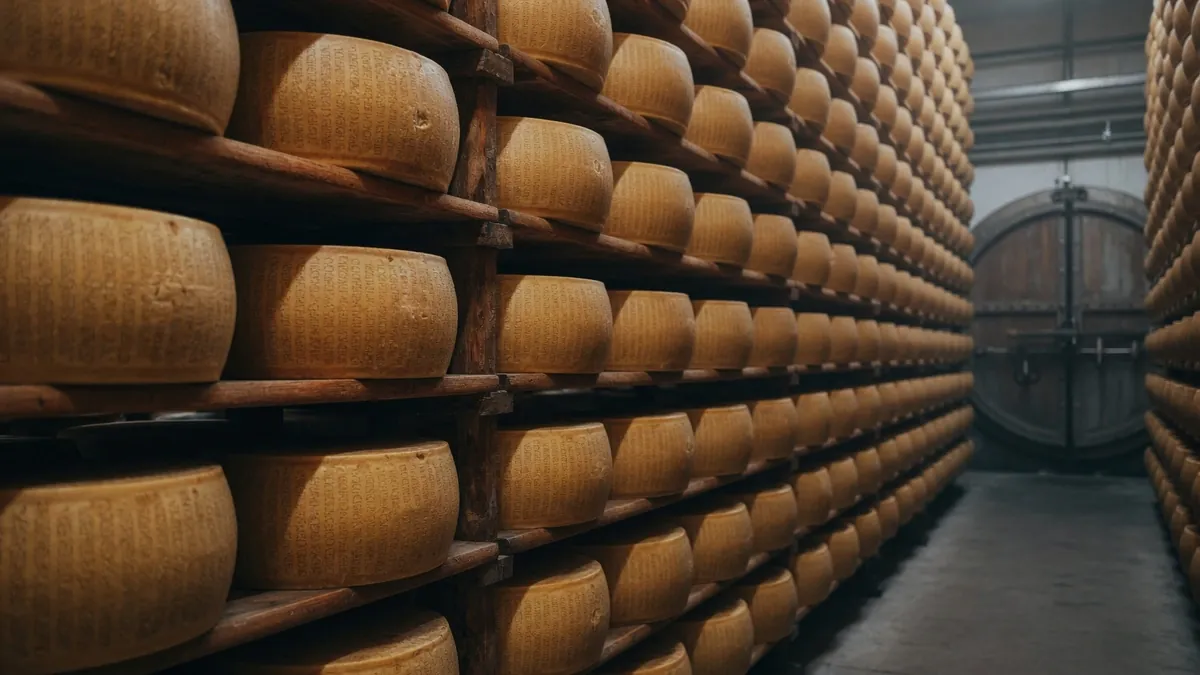
Parmigiano-Reggiano aged 24 months or more presents a paradox: it is made by a rennet-set process that should produce a meltable cheese, yet it frequently turns greasy and breaks into oil-and-solids when heated. The explanation involves the cumulative effects of extended proteolysis during aging.
Over 24 to 36 months, the bacteria and native enzymes within Parmigiano-Reggiano extensively break down casein proteins. The long protein chains that form the structural network are progressively hydrolysed (cut) into shorter peptides and free amino acids. This breakdown is what creates Parmesan's distinctive crystalline texture (tyrosine clusters), concentrated umami flavour, and granular consistency. But it also destroys the structural continuity of the casein network. When you heat very aged Parmesan, there is no intact, flexible protein network to hold fat in suspension and create a uniform melt. Instead, the fat separates out (the "greasing" effect), and the protein fragments clump or dry out.
This is why chefs add starchy water to pasta dishes when finishing with Parmigiano-Reggiano: the starch granules swell in water and create a viscous sauce that holds fat in suspension even when the protein structure cannot. The same principle applies to fondue, where wine (with natural tartaric acid and starch from flour or cornstarch) is used to create an emulsified sauce from aged Gruyère or Emmental.
Why Processed Cheese Melts Perfectly
Processed cheese (American cheese, cheese slices, Velveeta) is engineered specifically for uniform, smooth melt. Its exceptional melting behaviour comes from the addition of emulsifying salts, typically sodium citrate, disodium phosphate, or sodium polyphosphate. These emulsifying salts sequester calcium ions from the casein protein network, replacing calcium bridges with sodium-mediated connections. Calcium sequestration reduces the rigidity of the protein network and prevents protein aggregation when heated. The result is a cheese analogue that flows at lower temperatures, resists fat separation (because emulsifiers maintain the fat-water interface), and stays smooth across a wide temperature range.
James Kraft patented the original process for pasteurised processed cheese in 1916 (US Patent 1,186,524), describing the use of sodium phosphate salts to produce a shelf-stable, uniform product. The underlying chemistry has not fundamentally changed in over a century. Home cooks and restaurant chefs who want to replicate processed cheese's smooth melt in sauces made from natural cheese add sodium citrate directly; a teaspoon of sodium citrate dissolved in a small amount of water, then melted with any natural cheese, produces a smooth, emulsified sauce. This technique, popularised by modernist cuisine practitioners including Ferran Adrià and Nathan Myhrvold, is now widely used in restaurant kitchens.
The Maillard Reaction and Browning
Melting and browning are related but distinct phenomena. Cheese browns through the Maillard reaction between free amino acids (from proteolysis) and reducing sugars (primarily lactose or galactose remaining after fermentation). Higher proteolysis (more free amino acids) and higher residual sugar both increase browning tendency. Aged Cheddar browns more readily on pizza than fresh mozzarella partly because it has more free amino acids from longer aging.
The moisture content also affects browning: lower moisture concentrates both sugar and amino acids at the surface and raises the surface temperature faster. This is why low-moisture mozzarella browns on pizza while high-moisture fresh mozzarella does not brown to the same degree before it begins to liquefy.
Practical Guidelines for Cooking with Cheese
For smooth, unified cheese sauces (macaroni and cheese, fondue, cheese soup), choose younger cheeses with moderate moisture and add an emulsifier. The best natural choices are young Cheddar (6 months or less), young Gruyère, young Comté, Fontina Val d'Aosta, or Raclette. For applications requiring stretch (pizza, grilled sandwiches), pasta filata cheeses (mozzarella, provolone, string cheese) or young Gouda provide the best stringy pull. For grilling without melting (kebabs, saganaki, barbecue), use Halloumi, paneer, queso blanco, or any acid-set fresh cheese. For grating over finished pasta (where the cheese softens but does not fully melt), aged Parmigiano-Reggiano, Pecorino Romano, and Grana Padano are appropriate; avoid trying to melt these aged cheeses directly into sauces without an emulsifier.
Related: How to Make the Perfect Cheese Sauce | Cheese Aging: What Happens Inside the Cave | Sheep Milk vs. Goat Milk: Nutrition and Cheese Compared