Wales is surrounded by three of the most celebrated dairy nations in the world. England has its Cheddar, Stilton, and hundreds of artisan cheeses. Scotland has its Crowdie, Dunlop, and Caboc. Ireland has Kerrygold, Cashel Blue, and a grass-fed dairy tradition now famous globally. Wales, by contrast, is rarely named in the same breath with dairy excellence, and English-language food writing tends to cover Welsh food culture through the lens of lamb, leeks, and laverbread rather than milk and cheese. That omission is worth correcting. Wales has a distinct and ancient dairy tradition, a single native cheese with a history far more complex than its supermarket ubiquity suggests, and a small but serious artisan cheese revival that the broader food world has largely ignored.
The Origins of Caerphilly
Caerphilly (pronounced roughly "kair-FILL-ee") takes its name from the market town of Caerffili in the Rhymney Valley of South Wales, a few miles north of Cardiff. The town is best known outside Wales for its thirteenth-century castle, one of the largest medieval fortresses in Britain. The cheese connection is older, though precise origins are disputed by food historians.
The most commonly cited origin story places the first recognisable Caerphilly production in the Vale of Glamorgan in the late eighteenth or early nineteenth century, with the cheese being sold at Caerphilly market from around 1831. However, similar fresh, crumbly Welsh cheeses made from local cow's milk were likely produced on farms across the Welsh uplands for centuries before any commercial market formalised the type. Welsh agricultural records from the seventeenth and eighteenth centuries mention cheese production on hill farms in Glamorgan, Monmouthshire, and Breconshire, though these do not describe a standardised product.
What distinguished Caerphilly from the great English territorial cheeses (Cheddar, Cheshire, Double Gloucester) was its production method and its intended age. It was made quickly: using a relatively open, moist curd that was lightly pressed rather than heavily cheddared, lightly brined rather than deeply rubbed with salt, and sold young, typically within one to three weeks of production. This fast-to-market approach served the industrial working population of the South Wales coalfields extremely well.
Caerphilly and the Welsh Mining Industry
The coal industry that developed across the South Wales Valleys from the mid-nineteenth century created a large, physically demanding workforce with specific nutritional needs. Miners working long underground shifts required portable, calorie-dense, salt-containing food that could be carried in a jacket pocket and eaten without utensils. Caerphilly fit this role precisely. It was mild enough to eat in large quantities without fatigue, firm enough to wrap in a cloth and carry without disintegrating, high enough in protein and fat to provide sustained energy, and its salt content helped replace electrolytes lost through intense physical labour and sweating.
The cheese became so associated with Welsh mining communities that it was colloquially known as "the miner's lunch" or "the miner's cheese" in the valleys. By the late nineteenth century, Caerphilly was produced not only in Wales but in Somerset and other English dairy counties, where its fast production cycle (requiring only weeks of aging compared with months for Cheddar) made it commercially attractive for English dairies seeking quicker cash flow. This is a crucial point in understanding modern Caerphilly: a great deal of what was sold as Caerphilly by 1900 was produced in Somerset rather than Wales, a pattern that has continued into the present.
The Near-Disappearance and the Revival
The First World War devastated British artisan cheese production. Government requisition of milk for liquid consumption, restrictions on dairy processing, and the disruption of rural labour meant that many regional cheese varieties nearly disappeared. Caerphilly's quick production cycle actually gave it relative resilience compared with long-aged territorial cheeses, but Welsh farmhouse production contracted severely.
The Second World War dealt a more decisive blow. Wartime rationing centralised milk processing and effectively banned non-standardised cheese production in Britain. When rationing ended in 1954, most surviving Caerphilly production was industrial and English rather than Welsh and artisan. For several decades, Caerphilly existed primarily as a mass-produced supermarket product, uniform in texture, mild to the point of blandness, and without any geographic connection to the Welsh valleys that gave it its name.
The artisan revival that has restored genuine Welsh Caerphilly production is largely the work of a small number of dedicated farmhouse makers. The most significant is Trethowan's Dairy, based at Gorwydd Farm near Llanddewi Brefi in Ceredigion, West Wales. Todd Trethowan and his family have produced what is regarded by cheese specialists as the benchmark artisan Caerphilly since the late 1990s. Gorwydd Caerphilly is made from unpasteurised milk from a herd of Holstein-Friesian and Brown Swiss cows; it is aged for two to three months rather than the industrial standard of a few weeks; and it develops a grey-brown natural rind with a complex interior that progresses from creamy and slightly runny near the rind to chalky and lemony at the centre. It is a fundamentally different product from supermarket Caerphilly, in the way that a farmhouse Comté is a different product from processed Emmental slices.
How Caerphilly Is Made
Traditional Caerphilly production begins with full-fat cow's milk, warmed to approximately 30 to 32 degrees Celsius. A mesophilic starter culture is added, followed by animal or vegetable rennet to set the curd. The curd is cut into small cubes (roughly 1 centimetre) and gently stirred as whey drains. Unlike Cheddar production, the curd is not "cheddared" (stacked and milled to expel more whey and develop acidity) but instead is moulded relatively quickly while still moist, pressed lightly for 24 hours, then brined in a salt solution for 24 to 48 hours.
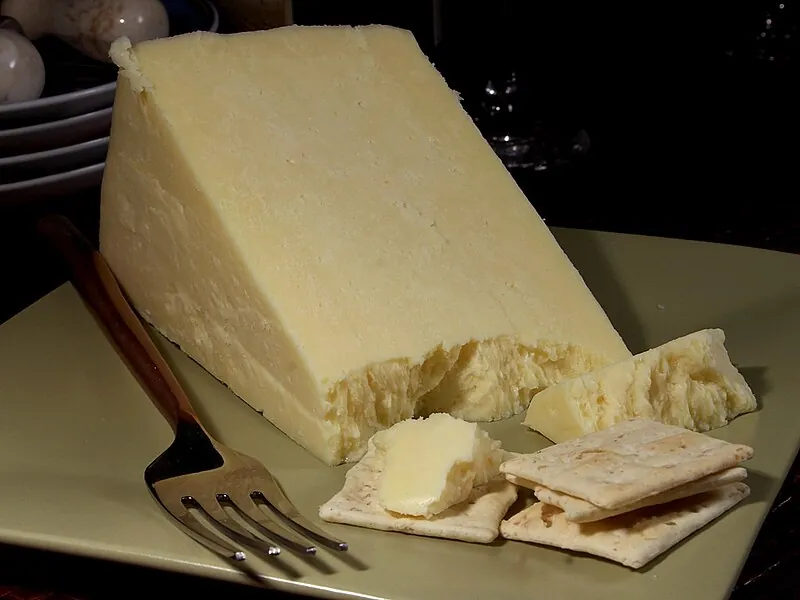
This brining stage is distinctive and explains Caerphilly's flavour profile. Surface-applied salt creates the rind and inhibits unwanted surface moulds, while the moist interior retains its clean, lactic freshness. Young commercial Caerphilly (two to four weeks) is white, very crumbly, quite mild, and slightly salty. Artisan-aged Caerphilly (two to three months) develops a natural rind colonised by grey and white moulds, while the paste develops more complex flavours: lemon, butter, mushroom, and a faintly mineral, grassy note.
Milk Composition
Caerphilly was traditionally made from cows' milk rather than sheep or goat milk, distinguishing it from many other Celtic dairy traditions. Wales does have a history of sheep farming, but commercial cheese production in Wales has been bovine-focused since at least the eighteenth century. The breed composition of herds used by Welsh dairy farmers historically included local improved Shorthorns and Welsh Blacks, though modern Welsh dairy herds are predominantly Friesian-Holstein, Brown Swiss, and crossbred cows.
Other Welsh Dairy Products and the Broader Welsh Food Tradition
Perl Wen and Perl Fynog
The artisan Welsh cheese revival has produced more than revived Caerphilly. Caws Cenarth, a farmhouse dairy near Newcastle Emlyn in Carmarthenshire, makes Perl Wen ("white pearl" in Welsh), a soft white rind cheese similar in style to Brie or Camembert, from their own pasteurised organic cows' milk. They also produce Perl Fynog ("mature pearl"), an aged version with a more assertive flavour. Caws Cenarth has won multiple awards at the World Cheese Awards and represents the broader artisan cheese movement in Wales that began in the 1990s.
Y Fenni
Y Fenni (the Welsh name for Abergavenny) is a flavoured Welsh cheese made from Cheddar-style base cheese mixed with mustard seeds and ale, giving it a distinctive tangy, yeasty flavour with a textured, slightly crunchy interior. It is produced commercially by Abergavenny Fine Foods and sold across the UK. While not a farmhouse artisan product, it represents a distinctly Welsh flavour combination and has significant commercial success.
Welsh Butter and Cream
Wales has historically produced salted farmhouse butter from high-fat milk from its dairy herds, particularly in the agricultural lowlands of Pembrokeshire, the Vale of Clwyd, and the Gower Peninsula. Before refrigeration, salt was added generously to extend shelf life, and Welsh butter was noted in eighteenth-century accounts for being distinctly saltier than English butter. This tradition predates the industrial butter market and has partial echoes in some contemporary Welsh farm shops and farmers' markets where cultured or lightly salted farmhouse butter can still be found.
Welsh Rarebit
Wales's most famous cheese-adjacent dish is Welsh Rarebit (not "rabbit," despite common confusion), a savoury sauce of melted Cheddar or Caerphilly, Worcestershire sauce, mustard, and often beer or ale, poured over toast. The earliest written recipe appears in Hannah Glasse's The Art of Cookery Made Plain and Easy (1747), where it is called "Welch Rabbit," suggesting the dish predates Glasse's recording. It remains a staple of Welsh café and pub menus and is one of the few dishes that specifically uses Caerphilly in its traditional form, though most modern versions use mature Cheddar for stronger flavour.
Caerphilly's Status and the Question of Protection
Unlike many European cheeses with Protected Designation of Origin (PDO) status, Caerphilly has no geographic or production-method protection under EU or UK law. This means that any producer anywhere in the world can legally make and sell a product called "Caerphilly," regardless of whether it bears any relationship to Welsh dairy tradition, artisan production methods, or the flavour profile of genuine farmhouse Caerphilly.
This has long frustrated Welsh dairy advocates and artisan producers. A 2019 campaign by the Welsh government and producers to seek PDO status for Caerphilly through the UK's post-Brexit geographic indication scheme stalled due to regulatory complexity and insufficient producer coordination. As of 2024, no PDO application for Caerphilly has been granted. The consequence is that supermarket aisles continue to offer mass-produced "Caerphilly" made in Somerset or further afield that shares a name but little else with the artisan product from Gorwydd Farm or Caws Cenarth.
Where to Find Authentic Welsh Dairy
For readers in the UK, Welsh artisan cheeses including Gorwydd Caerphilly, Perl Wen, and Y Fenni are available through specialist cheese retailers including Neal's Yard Dairy (London), The Fine Cheese Co. (Bath), and a growing number of Welsh farm shops and food festivals including the Royal Welsh Show and the Abergavenny Food Festival. Online retailers including Paxton and Whitfield ship Welsh cheeses throughout the UK. In the United States, Gorwydd Caerphilly is occasionally stocked by specialist cheesemongers in major cities; Fromagination in Madison, Wisconsin, and Murray's Cheese in New York have carried it at times.
The artisan Welsh cheese tradition is small, geographically concentrated, and under-resourced compared with the marketing infrastructure behind Cheddar or even Irish dairy. But the quality at its best, particularly Gorwydd Caerphilly aged to the point where the interior is silky and lemony and the rind carries earthy, mushroomy complexity, is genuinely exceptional. It deserves a wider audience than it currently finds.
Related: Irish Dairy and Kerrygold: A Guide to Ireland's Dairy Tradition | Danish Dairy: Lurpak, Havarti, and the Feta Dispute | How to Build the Perfect Cheese Board