Burrata is one of the most seductive cheeses in the world, not because it is complicated, but because it is almost impossibly simple. A thin shell of pulled mozzarella encloses a filling of stracciatella: shredded mozzarella soaked in fresh cream that spills out like a slow tide the moment you cut it open. It was invented around 1920 by Lorenzo Bianchino at the Bianchini farm near Andria, in Puglia, as a way to use up mozzarella scraps during times when refrigeration was unreliable. In 2016, Burrata di Andria was awarded Protected Geographical Indication (PGI) status by the European Union, formally recognising its roots in the Apulian tradition. Understanding what burrata actually is, and how to treat it correctly, is the difference between an extraordinary plate of food and a disappointing one.
What Burrata Is (and How It Differs from Mozzarella)
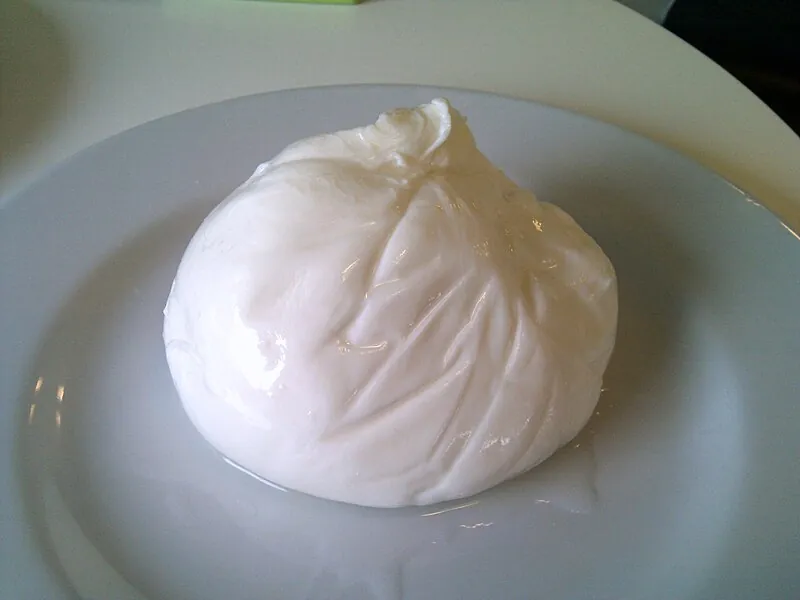
From the outside, burrata looks like a fresh mozzarella ball. The skin is indeed mozzarella, formed by the same pasta filata (stretched curd) process that gives mozzarella its characteristic chew. The difference is entirely inside. Where mozzarella is solid throughout, burrata contains stracciatella: strips of hand-pulled mozzarella mixed with panna (fresh cream). The word stracciatella comes from the Italian stracciare, meaning "to shred," and the filling is made by stretching curds into thin threads and saturating them in cream.
The result is a cheese with two completely different textures in one package. The outer shell is elastic and mild, with the familiar milky sweetness of fresh mozzarella. The inside is liquid, rich, and intensely creamy, with a fat content that can reach 55% in the dry matter. A standard burrata ball weighs 125g. The filling accounts for roughly 60% of that weight.
One practical consequence: burrata has almost no shelf life. It is best within 24 hours of production, and the deterioration after that is rapid. The shell begins to tighten, the filling separates, and the clean dairy flavour gives way to sourness. When buying burrata, check the production date, not just the best-before date.
Burrata di Andria PGI: What the Status Means
The 2016 PGI designation for Burrata di Andria specifies that the cheese must be produced in the Puglia region, using fresh cow's milk (or a blend of cow's and buffalo milk). The curd must be stretched using hot water, and the cheese must be sealed by hand, with the characteristic topknot visible at the top. PGI status does not prevent other regions from making burrata (it only protects the "di Andria" geographic qualifier), but it does guarantee that certified Burrata di Andria meets defined production standards.
Outside Puglia, burrata is now made across Italy and internationally. Quality varies enormously. Italian artisan producers typically use unpasteurised or minimally pasteurised milk and sell the cheese in its whey within hours of production. Supermarket burrata, by contrast, is almost always made from pasteurised milk, packaged in modified atmosphere, and travels for days before reaching the shelf. Pasteurisation is necessary for food safety at scale, but it reduces the volatile aromatic compounds that make fresh burrata taste extraordinary.
How to Buy Burrata
There are four things to assess when buying burrata. First, the production date: look for cheese made within the last 24 hours if you can find it, and plan to eat it the same day. Second, the packaging liquid: burrata should be stored in fresh whey or lightly salted water. If the liquid looks thick or cloudy beyond normal milkiness, the cheese is aging. Third, the weight: a standard single ball is 125g; mini burrata (50–75g) are increasingly available and useful for individual portions. Fourth, the smell: fresh burrata has a clean, milky aroma. Any sourness or ammonia notes signal age.
Italian delis and specialist cheese shops are a significantly better source than supermarkets for the reasons described above. If you can find a producer who ships direct (several Pugliese farms now ship to the UK and US overnight), the quality difference is remarkable.
How to Serve Burrata Correctly
The single most important rule: serve burrata at room temperature. Remove it from the refrigerator 30 minutes before serving. Cold burrata has a firm, rubbery shell and a thick, sluggish filling that loses its characteristic flow. At room temperature, the shell softens and the stracciatella becomes loose, unctuous, and fragrant.
Place the whole ball on a flat plate or board. Do not slice it in the kitchen. Bring it to the table whole and cut it open at the last moment, allowing the filling to run across the plate. This is not theatre for its own sake: exposure to air begins oxidising the cream immediately, and the filling should be eaten within minutes of cutting.
Classic Serving Combinations
- Heirloom tomatoes and basil: The canonical Pugliese presentation. Slice ripe tomatoes (use the best you can find, since the tomato is doing as much work as the cheese), season generously with flaked sea salt and black pepper, drizzle with a grassy extra-virgin olive oil, and finish with fresh basil. No balsamic vinegar: the acidity competes with the cream.
- Prosciutto di Parma and figs: A richer combination suited to late summer. The salt of the prosciutto and the sweetness of ripe figs bracket the cream perfectly. Use genuine Prosciutto di Parma DOP or San Daniele DOP; the quality of the cured meat matters as much as the cheese.
- Roasted stone fruit and honey: Roasted peaches or nectarines, still warm from the oven, alongside burrata at room temperature creates a temperature contrast that highlights both components. A drizzle of chestnut or acacia honey and some toasted pine nuts completes the plate.
- On pizza: Always add burrata after baking, not before. Place it on the hot pizza as it comes out of the oven, allowing the heat to warm (not cook) the filling over 60–90 seconds. If burrata goes into the oven, the filling disintegrates.
How to Make Stracciatella at Home
If you can make mozzarella at home (see the dedicated guide to 30-minute homemade mozzarella), making stracciatella is a short additional step. Take freshly made, still-warm mozzarella and pull it by hand into thin shreds directly into a bowl of cold fresh cream. The ratio is approximately 60% shredded mozzarella to 40% cream by weight. Season with a pinch of fine salt. The result will not be identical to Pugliese burrata made from raw milk, but it will be considerably better than most supermarket versions.
To make a burrata shell, you need the mozzarella still hot and pliable from stretching. Form it into a bowl shape in your palm, fill it with a generous spoonful of stracciatella, gather the edges together, and twist and pinch them shut to form the topknot. Work quickly; the mozzarella firms as it cools and becomes impossible to seal. Refrigerate in salted water and eat within 12 hours.
Shelf Life and Storage
Burrata keeps for 2–3 days maximum under refrigeration, stored in its packaging liquid. Once opened, it must be eaten immediately. There is no useful way to store leftover burrata: the filling separates and the shell toughens within hours of cutting. Plan accordingly and buy only what you will eat in one sitting. The standard 125g ball serves one as a starter or two as part of a sharing board.
Do not freeze burrata. The water content in the filling forms ice crystals that destroy the texture entirely on thawing. The result is grainy, watery, and unpleasant.
Why Freshly Made Burrata Beats the Supermarket Version
The gap between artisan and commercial burrata comes down to three factors. First, milk quality: producers using high-fat milk from grass-fed cows achieve a creamier, more complex flavour than those using standardised industrial milk. Second, pasteurisation temperature: HTST (high-temperature short-time) pasteurisation at 72°C for 15 seconds, the standard commercial method, destroys fewer of the aromatic volatile compounds in milk than ultra-high temperature (UHT) processing. Third, time: artisan burrata sold the day it is made has not undergone the protein tightening and cream separation that begins within 48 hours of production. If you eat burrata from a Pugliese farm on the day it is made, it is a different food from a supermarket tub bought three days after production. Both are called burrata. Only one is the real thing.
Related: Mozzarella at Home: The 30-Minute Method | Ricotta vs Cottage Cheese: When to Use Each