Clotted cream is one of Britain's most distinctive dairy products and one of its most scrutinised: few foods generate the level of passionate debate about correct preparation and serving as clotted cream does in the counties of Devon and Cornwall. Made by slowly heating unpasteurised or lightly pasteurised cream at a low temperature for many hours until a thick, golden-crusted layer of concentrated cream forms on the surface, clotted cream is among the richest dairy products consumed regularly anywhere in the world, with a minimum fat content of 55% (by UK legal definition under The Cream Regulations 1995) and a typical fat content in good Devon or Cornish production of 64% or higher. Its texture is unlike any other cream: thick enough to hold its shape on a spoon, with a slightly grainy quality from fat crystals that form during cooling, and a flavour that balances richness with a subtle, slightly caramelised nuttiness from the heating process.
What Makes Clotted Cream Different
Clotted cream is not simply very thick cream. The slow-heating process that creates it produces physical and chemical changes that distinguish it from double cream, crème fraîche, and every other cream product. When cream is heated slowly at temperatures between 75 and 90°C for 8 to 12 hours, several things happen simultaneously.
First, water evaporates, concentrating the fat and raising the fat percentage from the starting point (typically double cream at around 48% fat) to the final 55 to 64% range. Second, the fat globules in the cream partially coalesce and rise to the surface, forming the dense clotted layer. Third, at the surface, where temperature and concentration are highest, the Maillard reaction between the cream's lactose and proteins produces the golden-yellow crust and contributes the slightly nutty, caramelised flavour that distinguishes clotted cream from plain concentrated cream. Fourth, the cream's protein structure is altered by the sustained heat, contributing to the characteristic grainy texture that sets good clotted cream apart from an ordinary reduced cream.
Devon Clotted Cream PDO
Devon Clotted Cream has held Protected Designation of Origin (PDO) status under EU law (and now retained in UK law under Geographical Indication (GI) protection post-Brexit) since 1998. This means that only clotted cream produced in Devon, from Devon milk, using the traditional process, may legally be sold as "Devon Clotted Cream." The PDO specification requires a minimum fat content of 55% and the characteristic golden crust.
Rodda's Creamery in Cornwall has separately held PDO status for "Cornish Clotted Cream" since 1998 as well, protecting Cornish production with the same 55% minimum fat requirement. The two PDOs reflect both the genuine regional heritage of clotted cream production in southwest England and the commercial importance of the designation to regional dairy industries. Major Devon producers include Langage Farm, Quicke's (better known for cheese but also producing clotted cream), and Devon Cream Company. Rodda's is the dominant Cornish producer and the most widely distributed clotted cream brand in UK supermarkets.
The Devon vs Cornwall Debate: Cream First or Jam First?
This is, genuinely, a serious regional identity question in southwest England. The dispute is about the order in which clotted cream and jam are applied to a split scone during a cream tea.
The Devon tradition is cream first: the scone is split, spread with a generous layer of clotted cream (treating it somewhat like butter), and then jam (typically strawberry) is applied on top of the cream. The justification is that this allows the cream to function as the base, with the jam adding sweetness above it, and that the structural base of cream prevents the softer scone from soaking up the jam too quickly.
The Cornish tradition is jam first: the scone is split, spread with jam, and then clotted cream is spooned on top of the jam. The justification is that cream-on-top allows you to control the amount of cream precisely by eye and that the resulting presentation is neater (the cream sits as a distinctive white mound rather than being spread out of sight beneath the jam).
The debate escalated notably in 2010 when the Duchess of Cornwall (now Queen Camilla) publicly stated her preference for the Cornish method (jam first), triggering predictable indignation from Devon's dairy lobby. In 2018, the National Trust issued guidance standardising on jam first for their cream teas, prompting protests from Devon tourism bodies. Neither side has capitulated. From a culinary standpoint, the differences in flavour and texture are genuinely minor; the debate is primarily about regional identity and pride.
How to Make Clotted Cream at Home
Home production of clotted cream is straightforward but requires patience. The process takes approximately 12 hours of gentle oven heat plus several hours of refrigeration. The key requirement is starting with the right cream: you need double cream (48% fat in the UK) or a minimum 35% fat cream in other markets. Ultra-pasteurised (UHT) cream will not clot properly because the high-heat UHT process has already significantly altered the protein and fat globule structure; use standard pasteurised double cream.
Ingredients
- 600ml good-quality double cream (non-UHT, from a recognised dairy if possible; Guernsey or Jersey cream produces a richer result)
Equipment
- A wide, shallow ovenproof dish (a gratin dish or ceramic baking dish is ideal; wider surface area means more crust forms)
- An oven that can maintain a consistent low temperature (around 80 to 90°C)
- Clingfilm or a lid for refrigeration
Method
- Preheat your oven to 80 to 90°C (fan off if possible; fan ovens can dry the surface too quickly). Do not use the grill function.
- Pour the double cream into the wide, shallow dish to a depth of approximately 5 to 7cm. Shallower is better for more crust formation.
- Place the dish, uncovered, in the oven and leave undisturbed for 8 to 12 hours. Overnight is the traditional approach: put the cream in the oven before bed and remove it in the morning. The cream should not bubble or simmer; if it does, reduce the temperature slightly. The surface will gradually develop a golden-yellow skin.
- Remove the dish carefully from the oven without disturbing the surface crust. Allow it to cool at room temperature for 30 minutes, then cover and refrigerate for at least 8 hours (overnight is again ideal). This refrigeration step is essential for developing the correct texture: the cold causes the fat to crystallise, producing the characteristic slightly grainy consistency.
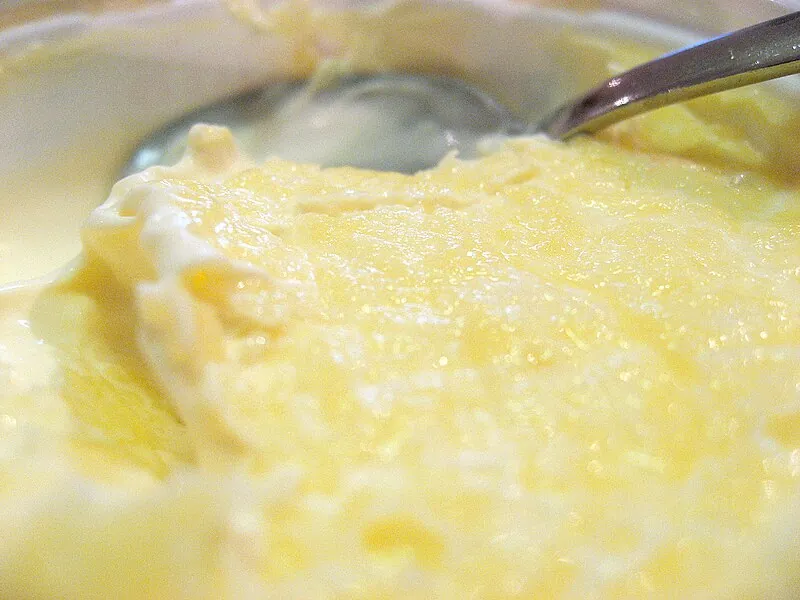
- After refrigeration, the clotted cream is ready. Use a large spoon to scoop it, including the golden crust. The cream beneath the crust will be thick and slightly off-white; the crust itself will be a deeper gold and more concentrated in flavour.
Yield and Storage
600ml of double cream yields approximately 350 to 400g of clotted cream plus approximately 150 to 200ml of thin cream (the liquid whey that separates and settles beneath the clotted layer). This thin cream can be used in cooking or poured over porridge. Homemade clotted cream keeps refrigerated for 3 to 4 days. Commercial clotted cream (which is heat-treated more precisely and may contain a small amount of stabiliser in some industrial products) has a shelf life of 1 to 3 weeks under refrigeration.
How to Serve Clotted Cream
The canonical serving is the cream tea: a split scone (plain or fruit), clotted cream, strawberry jam, and a pot of tea. The scone should ideally be freshly baked and still slightly warm (but not hot, which would melt the cream). Beyond the cream tea, clotted cream has uses across British baking and dessert making.
- With strawberries: A bowl of ripe strawberries with a pot of clotted cream alongside is the simplest possible summer dessert. No sugar or other additions are needed if the berries are properly ripe.
- On porridge: A Devonian tradition: a spoonful of clotted cream melted into hot porridge adds extraordinary richness. The cream melts around 45 to 50°C, so it should be placed on the porridge after serving, not stirred in during cooking.
- In fudge making: Clotted cream is used in Devon cream fudge, replacing or partly replacing standard cream in traditional vanilla fudge. Its higher fat content and caramelised notes produce a richer, more complex fudge with a creamier texture than double cream alone.
- In ice cream: Clotted cream produces an exceptionally rich vanilla ice cream. Its high fat content and natural grainy texture melt slowly in the mouth. Replace part of the double cream in a standard custard-based ice cream recipe with clotted cream for a deeply rich result.
Nutritional Profile
Clotted cream is an extremely energy-dense food. A tablespoon (approximately 30g) contains roughly 165 to 175 calories, 18 to 20g of fat (predominantly saturated), and minimal protein (less than 0.5g) and carbohydrate (less than 1g). It is, nutritionally, almost entirely saturated fat and is not a food associated with any health claims. It is a traditional, occasional pleasure best understood as such, produced in small quantities by individual dairy farms and creameries, and consumed in the context of a cream tea that is itself a relatively modest calorie event when the scone and jam are factored in.
Related: Types of Cream: Single, Double, Whipping, and Soured Explained | How to Make Butter at Home