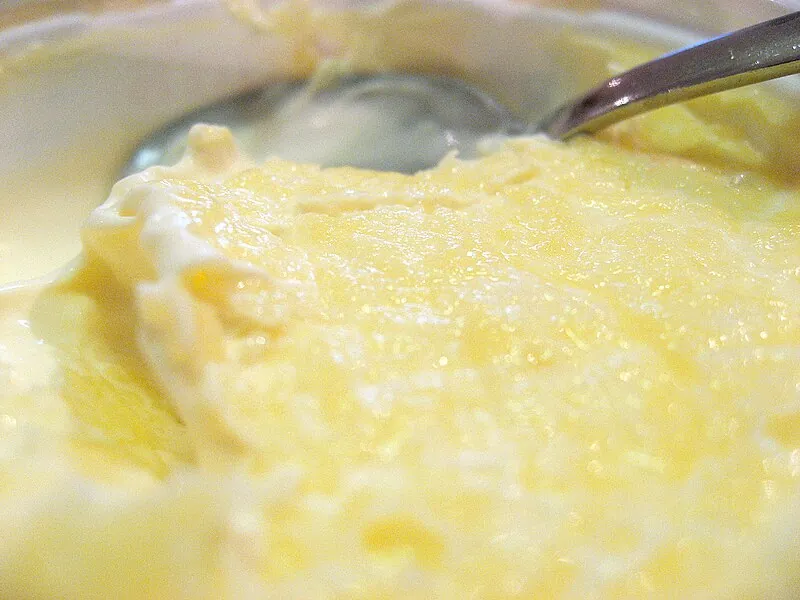
Clotted cream is one of the most calorie-dense, technically specific, and regionally contested dairy products in British food culture. At 55 to 65 percent milkfat, it is richer than whipping cream (35 percent fat), double cream (48 percent fat), and any commercially available cream sold outside the southwest of England and a handful of specialty producers in Ireland. Its production method is simple in principle and demanding in execution: whole cream is heated very slowly over many hours until a thick, golden-crusted layer of concentrated fat rises to the surface and sets into a dense, spreadable mass with a texture somewhere between soft butter and firm custard. The debate over whether to eat it with a scone by spreading the cream first (the Devon method) or the jam first (the Cornish method) has occupied newspaper columns, parliamentary Early Day Motions, and the Twitter feeds of otherwise sensible food writers for decades without resolution. Understanding clotted cream requires setting the scone debate temporarily aside and looking at what it actually is, how it is made, and why it tastes different from every other cream product on the dairy shelf.
What Clotted Cream Is and How It Is Made
Clotted cream is produced by the long, slow heating of full-fat unpasteurized or pasteurized whole milk or double cream in wide, shallow pans. The traditional Devon and Cornwall method uses whole milk (not pre-separated cream) heated in metal pans to approximately 75 to 95°C and held at that temperature for 6 to 12 hours, either in a low oven, over a water bath, or in a dedicated heated cabinet. During this extended low-temperature cooking, the fat globules in the milk rise to the surface and begin to coalesce; the heat denatures the surface proteins, which stabilize the fat layer and cause it to set into the characteristic thick, wrinkled, golden-yellow crust as the pan cools. This crust, called the "clout" or "clotted" layer (the word "clotted" in this context comes from the Old English "clot" meaning a lump or mass, not from blood coagulation), is skimmed from the pan and sold as clotted cream. The liquid remaining in the pan is thin, slightly caramelized skim milk that is fed to livestock in traditional farmhouse production.
Modern commercial production uses pasteurized Channel Island or high-fat British Friesian milk (or sometimes pre-separated double cream) processed in stainless-steel jacketed vessels at carefully controlled temperatures to ensure consistent fat content and food safety compliance. The UK Food Standards Authority requires clotted cream to contain a minimum of 55 percent milkfat, which distinguishes it legally and chemically from all other cream grades sold in the UK market. In practice, authentic Devonian and Cornish clotted creams run 58 to 65 percent fat. The high fat content gives clotted cream its distinctive richness, its soft but solid texture (it holds a peak but does not pour), and a mild caramelized, slightly cooked-cream flavor with a faintly sweet nuttiness contributed by the heat-induced lactose browning that occurs during the long slow heating.
The color of clotted cream ranges from ivory-white to deep golden yellow, depending on the season and the breed of cattle supplying the milk. Cream produced from cows grazing on grass in spring and summer contains more beta-carotene (the pigment responsible for the yellow color of butter and cream) than cream from hay-fed cows in winter, so summer clotted cream is typically more golden. Channel Island breeds (Jersey and Guernsey cows) produce milk with a particularly high beta-carotene content due to their efficient conversion of dietary carotenoids, and clotted cream made from Channel Island milk is noticeably more yellow than that made from British Friesian or Holstein milk.
PDO Protection and Regional Identity
Cornish Clotted Cream received Protected Designation of Origin (PDO) status from the European Commission in 1998, a recognition that the specific combination of Cornish milk, traditional production method, and local climate and terroir produces a product with characteristics not replicable outside the designated region. The PDO applies to cream made from the milk of cows kept in Cornwall and processed in Cornwall using the traditional scalded cream method. It does not apply to Devon clotted cream, which is produced under very similar methods in the neighboring county but which has not received a separate PDO designation. Devon clotted cream is protected only to the extent that it can be labeled "Devon Clotted Cream" if it is genuinely made in Devon from Devon milk.
The distinction between Cornish and Devon clotted creams is, to most consumers, imperceptible in blind tasting. Both are made by the same fundamental process, both use high-fat milk from British dairy breeds, and the flavor profile is more dependent on the specific farm, the season, and the freshness of the cream than on which county it comes from. However, the two counties maintain competing traditions around the product that extend well beyond the cream itself, primarily in the form of the cream tea debate.
The Devon vs Cornwall Scone Debate
A cream tea consists of freshly baked scones served warm, a pot of tea, a dish of clotted cream, and a jar or bowl of jam (strawberry is standard; raspberry is acceptable in many establishments; anything else is controversial). The debate is about the order of assembly on the scone.
The Devon convention is to split the scone, spread clotted cream thickly on each half first (as you would spread butter on bread), and then place a smaller spoonful of jam on top of the cream. Devon bakeries and tearooms are consistent on this point, and the Devon County Council has formally endorsed the cream-first method in tourism literature. The practical argument for the Devon method is that it uses the cream as a base, allowing the jam to sit visibly on top and mix with the cream as you eat, and that it puts the more abundant ingredient (cream) in the substrate position, resulting in a more generous-seeming presentation.
The Cornish convention is the opposite: jam is spread on the split scone first, and cream is placed on top of the jam. The Cornish rationale is that the cream, being softer and more spreadable than jam, sits more naturally as the top layer, and that Cornish clotted cream is rich enough to be its own flavor rather than a background to jam. In 2010, the Cornish MP Dan Rogerson raised the matter in the House of Commons, prompting a ministerial response confirming that the government of the day had no position on scone assembly order. The issue attracted earnest coverage in The Guardian, The Telegraph, and the BBC, none of which resolved it.
Food historian Laura Mason, in her 2004 book "Traditional Foods of Britain," notes that the earliest documented references to the cream tea as a formal service (as opposed to simple farm tea with cream) date to the Tavistock Abbey estates in Devon around the 11th century, giving Devon a historical priority claim that Cornwall disputes. The debate, like most genuinely important controversies, will probably never be settled to universal satisfaction.
A pragmatic position, held by many professional pastry chefs including Claire Clark (former Head Pastry Chef at The French Laundry), is that the order is irrelevant and the quality of all three components matters more than their sequence. A warm, freshly baked scone made with good butter, a high-quality clotted cream at 60 percent fat, and a jam made from fresh fruit with low added sugar is a substantially better experience than a cold, commercial scone with mediocre cream and high-fructose-corn-syrup jam in any assembly order.
The Best Clotted Cream Producers and Where to Find It
Rodda's, based in Redruth, Cornwall, is the largest commercial producer of Cornish Clotted Cream PDO, with annual production of approximately 2,500 tonnes. Their clotted cream is sold at most major UK supermarkets (Tesco, Sainsbury's, Waitrose, and Ocado) in 113-gram and 227-gram tubs at £2.00 to £3.50, and is exported to more than 30 countries. Rodda's has been producing clotted cream since 1890 and uses Cornish milk that meets British Friesian and Channel Island breed standards.
Trewithen Dairy, also in Cornwall, produces a cream with a notably higher fat content (frequently measured at 63 to 65 percent) and a richer, more intensely caramelized crust than the Rodda's standard product, a difference attributed to a slower, longer heating process. Trewithen is available at Waitrose and specialist farm shops in Cornwall and Devon, as well as through direct mail order, at approximately £4 to £6 for 227 grams.
In Devon, Langage Farm in Plymouth is a well-regarded producer whose clotted cream is made from the milk of their own Holstein-Friesian and Jersey herd and sold at farm shop prices and through selected South West retailers. Langage's Jersey blend cream is notable for its deep yellow color and buttery flavor, and has won multiple Great Taste Awards from the Guild of Fine Food.
For visitors to the southwest of England, the best cream teas are typically found at farm shops rather than tourist-focused tearooms. The Cornwall and West Devon Mining Landscape World Heritage Site visitor centers and National Trust properties including Lanhydrock House and Cotehele House reliably serve genuine Cornish Clotted Cream PDO at their cafes, as the National Trust specifies regional provenance in its catering standards.
Clotted Cream Beyond the Scone
Outside the cream tea context, clotted cream has several culinary applications that deserve more attention than they typically receive. Its very high fat content makes it an exceptional enrichment for sauces (a spoonful stirred into a reduced butter sauce at the end adds body and a mild caramelized note), and its stability at moderate temperatures (it does not break or curdle as readily as double cream when added to hot liquids) makes it practical for finishing savory dishes. Rick Stein's restaurant chain in Padstow, Cornwall, uses clotted cream in several fish and seafood preparations, including a clotted cream and crab tart that appears regularly on the seasonal menu.
Clotted cream ice cream, made by substituting clotted cream for some or all of the double cream in a standard ice cream base, produces an ice cream with a pronounced caramelized dairy note and a denser texture than standard cream-based recipes. Several Devon and Cornwall creameries, including Salcombe Dairy and Kelly's of Cornwall, sell clotted cream ice cream commercially, with Kelly's reaching national UK distribution through Sainsbury's and Tesco at approximately £3.50 per 500-milliliter tub.
Clotted cream fudge is a West Country specialty made by cooking clotted cream with sugar and butter to a fudge temperature (approximately 118°C) rather than the hard-crack stage of traditional boiled sweet production. The result is a softer, creamier fudge with a distinct clotted cream flavor, produced and sold by many Devon and Cornwall confectioners including Roly's Fudge (with shops in Brixham, Dartmouth, and Totnes) and Furniss of Cornwall. These make excellent and inexpensive souvenirs from the region.
Related: Crème Fraîche vs Sour Cream: Cultured Creams Compared | Heavy Cream Guide: Double Cream, Whipping Cream, and More | Irish Dairy: Kerrygold, Galtee, and What Makes Irish Butter Special