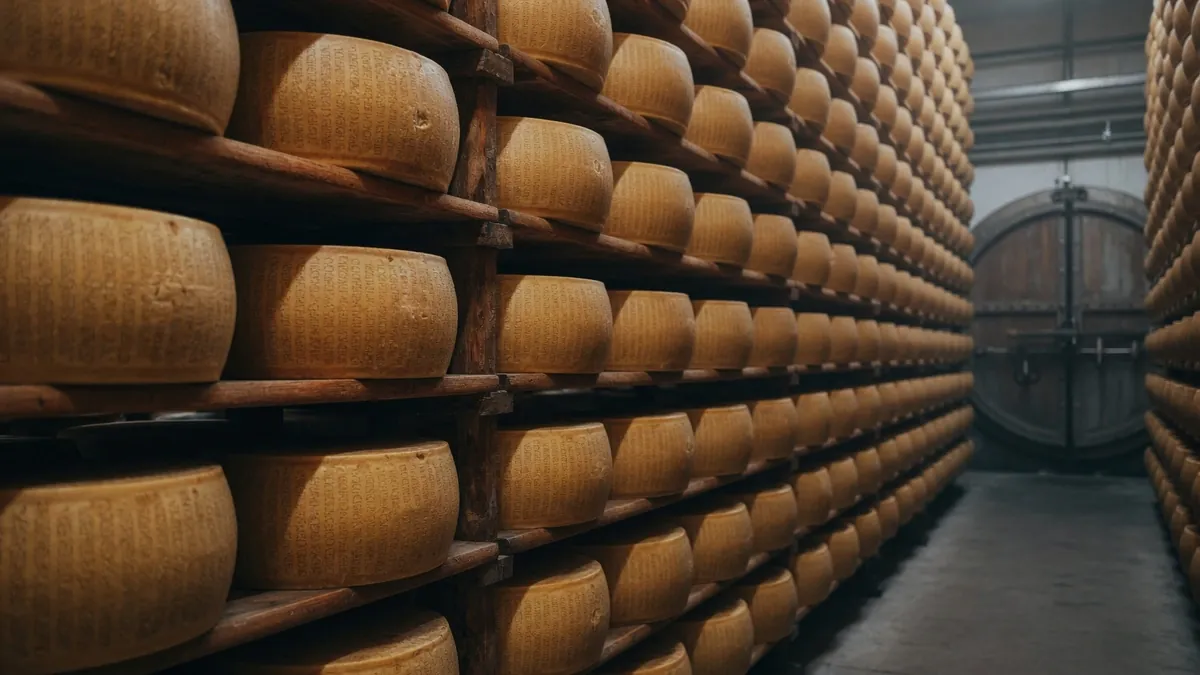
In Italian supermarkets, Grana Padano and Parmigiano-Reggiano occupy adjacent shelves and look, at first glance, nearly identical: both are golden-yellow, hard, grainy, rind-protected wheels sold by the wedge and destined for a grater. The confusion is understandable, and many Italian home cooks use the terms interchangeably in casual conversation. But the two cheeses are governed by separate DOP disciplinari, produced in different (though overlapping) geographic zones, made under distinct rules concerning the milk allowed, and priced accordingly. Grana Padano is consistently the world's highest-selling DOP cheese by volume; Parmigiano-Reggiano is widely regarded as among the finest cheeses produced anywhere. Knowing the specific differences between them, not just vaguely but in terms of the production rules, flavour development, and best culinary uses, makes you a more confident and economical cook.
A Brief History of Two Parallel Traditions
Both cheeses trace their origins to Cistercian and Benedictine monasteries in the Po Valley during the 12th century, when monks developed hard, long-keeping cheeses as a way to preserve milk surplus from the dairy herds they maintained. The earliest written reference to a cheese recognisable as the ancestor of Parmigiano-Reggiano appears in a notarial deed from Genoa dated 1254, in which the cheese is described as "caseus parmensis" and traded as a commodity. Grana cheeses of the Po Valley are documented in similar sources from roughly the same period.
The two traditions diverged over the following centuries as different guilds and geographic communities formalised their respective production methods. The Parmigiano tradition consolidated around the provinces of Parma, Reggio Emilia, and Modena, becoming one of the most regulated and prestige-laden dairy traditions in Italy by the Renaissance. The grana tradition, producing a broader category of "grana" (grainy) cheeses, was formalised into the Grana Padano consortium in 1954, when producers from the broader Po Valley region sought DOP-predecessor protections for their distinct style.
The Production Zones: Where Each Cheese Is Made
The geographic differences are fundamental and non-negotiable under DOP law.
Parmigiano-Reggiano DOP is produced exclusively in the provinces of Parma, Reggio Emilia, Modena, and parts of Mantua (Mantova, on the right bank of the Po) and Bologna (on the left bank of the Reno). This is a tightly defined area of approximately 10,000 square kilometres in the Emilia-Romagna region. No Parmigiano-Reggiano can be produced outside this zone, regardless of the method, milk, or producer.
Grana Padano DOP covers a much larger territory. The production zone spans 30 provinces across five regions: Piedmont (Alessandria, Asti, Cuneo, Novara, Vercelli, Biella, and Verbano-Cusio-Ossola), Lombardy (Bergamo, Brescia, Como, Cremona, Lecco, Lodi, Mantua, Milan, Monza, Pavia, Sondrio, Varese), Trentino-Alto Adige (Trento), Veneto (Padua, Rovigo, Treviso, Venice, Verona, Vicenza), and Emilia-Romagna (Bologna, Ferrara, Forlì-Cesena, Piacenza, Ravenna). The name "Padano" refers to the Po (Padus in Latin) River basin, which the production zone largely follows.
This geographic difference has major commercial consequences. With a production zone covering most of northern Italy, Grana Padano producers have access to a much larger milk pool and can operate at higher volumes and lower per-unit costs. In 2023, approximately 5.4 million wheels of Grana Padano were produced, compared with approximately 3.8 million wheels of Parmigiano-Reggiano. Grana Padano has been the world's best-selling DOP cheese by volume for over 20 consecutive years.
The Milk: A Critical Rule Difference
The most practically significant technical difference between the two cheeses concerns the milk rules.
Parmigiano-Reggiano must be made from the raw (unpasteurised) milk of cows that live and are fed within the production zone. The DOP disciplinare specifies that cows must be fed predominantly on local grass and hay; silage (fermented fodder) is strictly prohibited. This rule is not merely traditional; it prevents silage-derived Clostridium spores from entering the cheese and causing internal gassing defects during ageing. The milk used is partially skimmed: evening milk is left to rest overnight and the cream that rises is skimmed off for butter production before the skimmed evening milk is combined with whole morning milk. This partial skimming is a defining step that influences the fat content of the final cheese.
Grana Padano also uses raw milk from cows within its zone, but the silage prohibition is not total. The Grana Padano disciplinare permits silage-fed milk provided that the milk is tested and treated with lysozyme (an enzyme derived from egg whites) to inhibit Clostridium activity during ageing. This is why Grana Padano wheels carry a disclosure that the cheese contains lysozyme (a potential allergen for those with egg allergies), while authentic Parmigiano-Reggiano does not.
Both cheeses use natural whey starter (scotta innesto) from the previous day's production as the acidification agent rather than commercial freeze-dried starters. This approach, which is specified in both DOP disciplinari, perpetuates a live microbial culture from one day's production into the next, creating a degree of continuity in the microbiological character of each dairy's cheese over time.
Minimum Ageing and Grade Classifications
Both cheeses have formal grade structures based on ageing, but the scales are different.
Parmigiano-Reggiano Ageing Grades
- Parmigiano-Reggiano (minimum 12 months): The youngest DOP-certified grade. Still relatively moist, with a mild, milky, and slightly tangy flavour. Rarely seen at retail because most buyers prefer longer-aged examples.
- Vecchio (minimum 18 months): More developed flavour, beginning to show the characteristic grainy tyrosine crystals that indicate proteolysis (protein breakdown) during ageing. This is the most common retail grade in Italian supermarkets.
- Stravecchio (minimum 24 months): The standard premium grade. Intense, complex, with strong umami character, fruity notes, and pronounced crystalline crunch. Most exported Parmigiano-Reggiano in the United States and UK falls at 24 months.
- Extra-vecchio (minimum 30 months): Available from specialty producers and affineurs. Significantly drier and more concentrated, with a deep amber paste and intense savoury-sweet complexity.
- Aged 36 months and beyond: Some producers and affineurs mature wheels to 36, 40, or even 60 months. At extreme ages, the cheese becomes almost crystalline throughout, with an intensely sweet and aromatic character. A 36-month wheel retails in Italy at approximately 30 to 35 euros per kilogram.
Grana Padano Ageing Grades
- Grana Padano (minimum 9 months): The entry grade, younger and more supple than any Parmigiano-Reggiano grade, with a pale golden paste and mild flavour that melts easily.
- Grana Padano Over 16 Months: More developed, grainier texture, stronger flavour. The transition grade used in cooking applications requiring more assertive flavour.
- Grana Padano Riserva (minimum 20 months): The top tier, applied only to wheels that passed exceptional quality inspection at 18 months. Labelled with a special fire-branded mark. Riserva approaches the flavour intensity of younger Parmigiano-Reggiano but retains a slightly softer texture.
Flavour Profile and Texture Differences
Having tasted wheels of both at various ages, the differences are real but require attention to perceive clearly in the younger grades. At equivalent young ages (under 18 months), Grana Padano tends to be slightly softer, milder, and more buttery, with a less pronounced crystalline texture. Parmigiano-Reggiano at the same age is slightly drier and has a more forward lactic and grassy character.
At 24 months and above, the gap widens. Aged Parmigiano-Reggiano develops intense umami from glutamates and aspartates released during proteolysis, with a complex finish combining fruity esters, warm spice, and a characteristic crystalline crunch from tyrosine amino acid clusters that form throughout the paste. The Consorzio del Formaggio Parmigiano-Reggiano's technical documentation notes that a 24-month wheel contains more than 400 distinct volatile flavour compounds identified by gas chromatography studies conducted by researchers at the University of Parma.
Grana Padano Riserva at 20 months is excellent and genuinely complex, but it typically lacks the full crystalline development and flavour depth of 24-month Parmigiano-Reggiano. Part of the explanation lies in the milk: the stricter no-silage rule and the specific Emilian cow breeds (primarily Italian Friesian, Reggiana, and Bianca Modenese) produce milk with slightly different fat and protein compositions compared with the more diverse milk pool of the Grana Padano zone. A 2019 metabolomic study published in Food Chemistry by researchers at the University of Bologna identified distinct volatile compound profiles in Parmigiano-Reggiano versus Grana Padano, with Parmigiano-Reggiano showing higher concentrations of short-chain branched aldehydes and lactones associated with complex aged-cheese flavour.
Price Comparison and Value Assessment
The price gap between the two cheeses is significant and reflects both the more restricted production zone and the longer mandatory ageing of Parmigiano-Reggiano.
In Italian supermarkets as of early 2025, freshly cut Grana Padano (standard grade, approximately 12 months) retails at 9 to 11 euros per kilogram. Grana Padano Riserva runs 13 to 16 euros per kilogram. Standard 24-month Parmigiano-Reggiano retails at 15 to 20 euros per kilogram. A 36-month Parmigiano-Reggiano from a named caseificio can reach 28 to 35 euros per kilogram.
In the United States, imported Parmigiano-Reggiano (24 months) typically retails at 18 to 25 dollars per pound (approximately 40 to 55 dollars per kilogram) at specialty retailers and Whole Foods. Imported Grana Padano runs 10 to 16 dollars per pound. Pre-grated versions of both cheeses in shelf-stable containers represent a lower cost option but with meaningfully lower flavour due to oxidation and the use of anti-caking agents.
For everyday cooking where the cheese will be melted into a sauce, incorporated into pasta dough, or used as a component in a complex dish, Grana Padano offers excellent value and is the economically rational choice. For finishing dishes, grating over pasta at the table, or serving as a cheese course where the flavour of the cheese itself is the focus, the price premium of Parmigiano-Reggiano is generally justified.
Culinary Uses: When to Use Each
Both cheeses are primarily used grated, and both dissolve smoothly in hot applications, but their different intensities and price points suggest distinct use cases.
Grana Padano is the better choice for large-volume cooking: filling for pasta (tortellinii, ravioli), risotto bases where the cheese contributes body and salt, béchamel enrichment, bread and focaccia toppings, and Parmesan-crusted baked dishes. Its milder, butterier flavour is less likely to overpower delicate applications and its lower cost makes using generous quantities economically sensible.
Parmigiano-Reggiano aged 24 months or more is the finishing cheese: grated tableside onto pasta, polenta, or minestrone; broken into shards to serve on a cheese board; used in small quantities in preparations where the cheese flavour should be prominent and distinct. Classic Italian applications that specifically feature the cheese, such as a Parmigiano-Reggiano broth (made by simmering a rind in chicken or beef stock) or a parmigiana di melanzane where the cheese layer is a key flavour statement, benefit from the real thing.
Rinds of both cheeses should never be discarded. Added to bean soups (pasta e fagioli), lentil soups, and long-simmered ragù, the rind releases glutamates and proteins that enrich the broth in the same way as a parmesan rind used more familiarly in Italian-American cooking. The Grana Padano rind performs equally well in this role at a lower cost.
Spotting Authentic Cheese
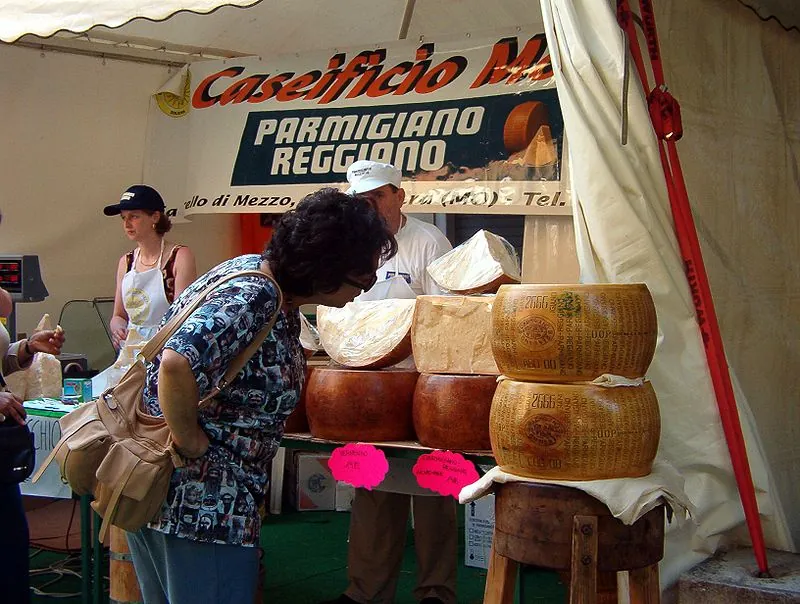
Both cheeses have their origin markings stamped directly into the rind of the wheel using a die-press during production. Authentic Parmigiano-Reggiano has "PARMIGIANO-REGGIANO" repeated in dotted letters around the entire circumference of the wheel, plus the producer number and production month and year. Authentic Grana Padano has an oval logo with a rhombus pattern stamped into the rind and the text "GRANA PADANO" visible on the rind. When buying pre-cut wedges, look for the rind markings on the cut piece as confirmation of authenticity.
Pre-grated "parmesan" sold in green cylinders by brands such as Kraft does not meet the DOP criteria for either cheese. It may contain cellulose anti-caking agents and a blend of domestic and imported dairy not produced under DOP rules. Its flavour is substantially different from freshly grated DOP cheese and it does not melt in the same way. For cooking, buying a small wedge and grating it yourself is consistently preferable on flavour and cost-per-flavour grounds.
Related: Gorgonzola DOP: Dolce vs Piccante and How to Pair Italy's Greatest Blue Cheese | The Science of Cheese Melting: Why Some Cheeses Flow and Others Stretch